Tightness in one hip is common, but it can make walking and exercising near impossible. Get treatment to get the spring back in your step.
You wake up ready to start your day. Instead of moving easily, you feel nagging tightness in one hip that makes even walking to the kitchen uncomfortable. The stiffness continues while sitting at your desk or during exercise. Why is only one hip tight, and what can you do about it?
The answer lies in the complex structure of the hip joint. While you may think of the hip as a single bone structure, it is supported by multiple muscles that allow for flexibility and strength. When the hip flexor muscles tighten, everyday movements such as walking, climbing stairs, exercising, and standing can become difficult. Even tightness on just one side can disrupt your movement patterns and lead to pain elsewhere if left untreated.
Why one side of your hip might feel tight
Most often, tightness develops because the hip flexor muscles on that side have shortened. Located at the front of your hips, the flexors allow you to extend and lift your knee as well as rotate your hip. They also stabilize the pelvis when you walk, stand, or run. Essentially, every move you make in your lower body is possible because of your hips.
You’ll know if your hip flexors are tight from these signs:
- A pulling sensation in the front of the hip
- A dull ache in the lower back
- Tenderness when pressing on the hip flexors
- A “pinch” in the hip joint when you bring your knee to the chest
- A clicking sound in the hip when moving your leg
- Tightness increases after prolonged sitting, exercising, climbing stairs, and squatting
Common causes of hip tightness on one side
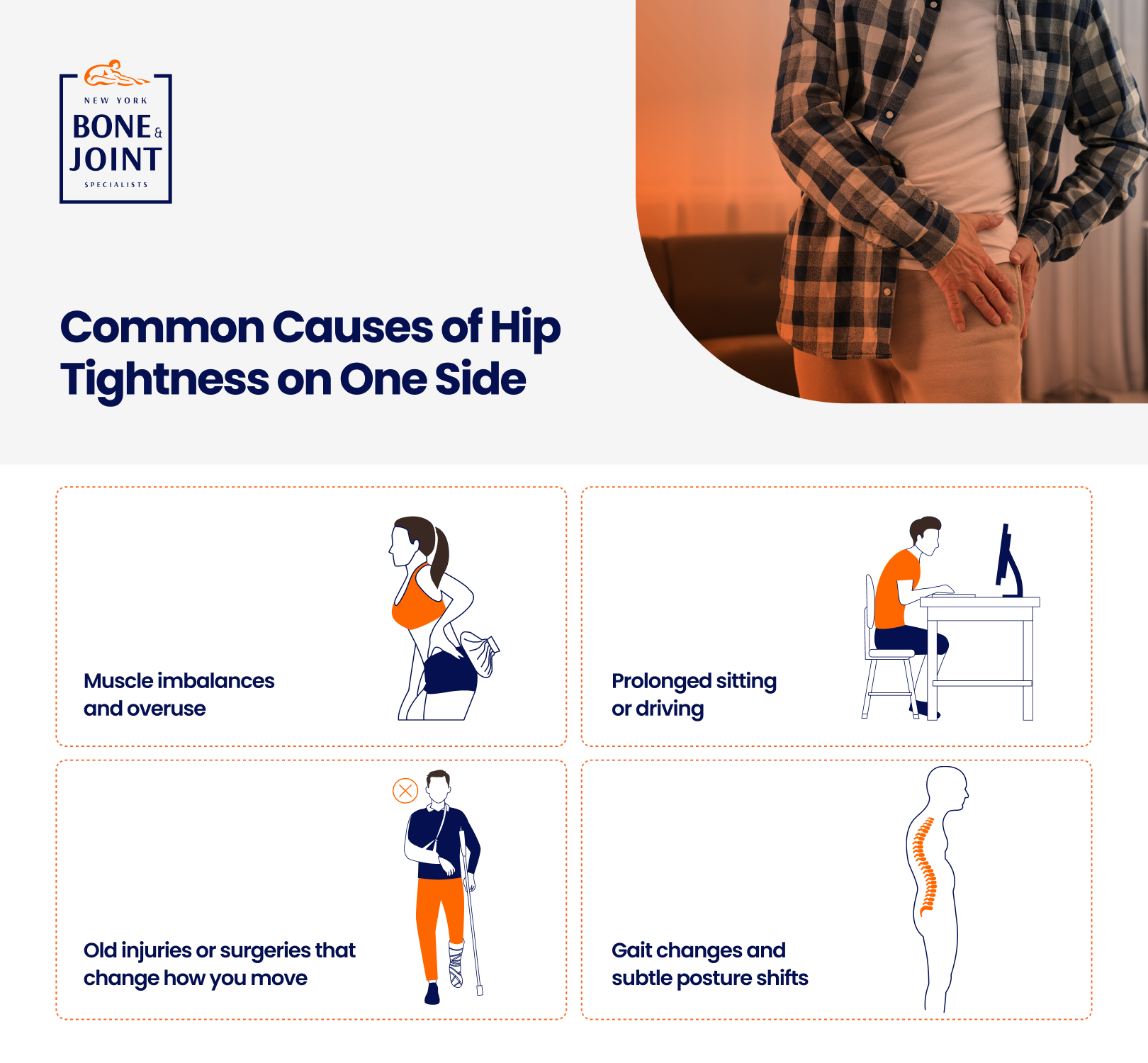
A tight hip on one side can be attributed to structural abnormalities or your lifestyle. Here are some common causes:
- Sitting for long periods. Prolonged sitting at a desk or behind the wheel of a car shortens the flexors, eventually leading to tightness.
- Muscle weakness. The flexors become stressed when they overcompensate for weak glutes and deep core muscles.
- Poor posture. Your hip flexors tense up if you tilt your pelvis forward while standing.
- Repetitive activity. Runners, cyclists, and athletes who lift their hip flexors repeatedly raise their risk of overusing the flexor muscles.
- Different leg lengths. People born with uneven leg lengths can develop a lateral pelvic tilt, or having one hip higher than the other.
- Scoliosis. An abnormal curvature of the spine sometimes causes a misalignment of the pelvis and hip.
- Fallen arches. Flat or fallen arches can pull the hip out of its normal position.
How a tight hip can lead to pain on the same side
Your body is constructed so each joint and every muscle carries the weight of your body equally. One weak area, however, can push a heavier workload on another part of the body, and that can affect nearby joints and muscles.
Hip tightness can trigger a chain reaction affecting other muscles and joints as they overcompensate for the affected hip. This can happen even if your hip doesn’t feel particularly stiff and tight.
In turn, this can lead to:
Lower back pain. The hip flexors connect the lower back through the pelvis. Tense hip flexors strain the lower back and cause pain.
Knee pain. Tight hip flexors push the pelvis forward, throwing the kneecap out of position and causing pain along the outer knee.
SI joint/pelvic pain. The sacroiliac (SI) joint connects the bottom section of your spine (the triangle-shaped sacrum made of fused vertebrae) to the ilium, the top part of your pelvis. Pain in the joint can be due to several causes, two of which are different leg lengths and flexor muscle tightness.
Hip pain. Activities involving multiple hip extensions or flexes can be painful if the hip flexors are rigid. The pain centers in the front of the hip, but may extend to the lower back and down the leg.
Tightness vs. injury: How to tell what you are feeling
Hip tightness on one side can be a standalone and treatable condition. On the other hand, pain and stiffness could also indicate an injury or other orthopedic condition.
- Fracture. A fall can cause a fracture in the upper part of the thigh bone (femur).
- Labral tear. The cartilage lining the hip joint socket ruptures.
- Bursitis. The small, fluid-filled sacs protecting the hip joint become inflamed.
- Dislocation. A high-impact trauma like a car accident knocks the head of the femur out of the hip socket.
Symptoms of a hip injury typically occur immediately after the trauma and may result in:
- Sudden sharp pain
- Stiffness
- Bruising and swelling
- A popping or clicking sound
- A limp when walking.
Quick self checks that can reveal a tight hip
Want to know whether your hips are tight on one side? These quick at-home tests can tell you:
Observe your foot rotation. Lie flat on your back and let your feet turn out to each side. If one foot rotates outward more than the other, you could have a tighter hip on that side.
Test hip flexion. Lie on your back and try to pull your knee to your chest. If you can’t, you may have a tight hip flexor.
Inability to do routine activities. Difficulty climbing stairs or getting out of a chair indicate tight hip flexors.
Check external hip rotation. Position yourself on your hands and knees. Attempt to lift the affected leg outward. Inability to perform that move indicates a tense hip flexor.
Trendelenburg sign (for lateral pelvic tilt):
- Stand in front of a mirror
- Place your hands flat on the highest point on both sides of your waist line
- Stand on one leg for 10 seconds
- Perform a single leg squat
- Observe any tilt in the pelvis throughout this test
- Compare both sides
How orthopedic specialists identify a tight hip flexor
An orthopedist can perform a series of tests to determine if your hip limitations are due to tight flexors. Several check points include:
- Poor posture and difficulty standing up straight
- Tightness or ache in the lower back, particularly when standing
- Painful glutes
The Thomas test:
- Lie on your back on an examining table
- Bring both knees to your chest
- Hold your right knee against your chest and straighten your left leg
- Lower your left leg as far as possible
- Repeat on the other leg
If you cannot lower one leg to the table surface, your hip flexor on that side is probably tight.
Treatment options for hip tightness and pain
Fortunately, hip tightness is a very treatable condition. A physical therapist can help you develop a comprehensive therapy plan.
Targeted physical therapy. Exercises will focus on strengthening and stretching the flexors and surrounding muscles. One note of caution: Stop if you feel intense pain.
Pigeon stretch to improve hip flexor flexibility
- Begin on your hands and knees in a tabletop position
- Bring your right knee forward and place it behind your right wrist
- Place your right ankle in front of your left hip.
- Straighten your left leg behind you, keeping your left knee straight and your toes pointed
- Keep your hips square
- Gently lower yourself to the ground
- Stay in this position for up to 10 seconds
- Release the position by pushing on your hands, lifting your hips, and moving the legs back into your starting position on all fours
- Repeat on the other side
Glute bridges to strengthen the glutes and support the flexors
- Lie on your back with your knees bent and feet flat on the floor
- Lift your hips toward the ceiling while squeezing your glutes
- Hold for a few seconds before lowering back down
Maintain proper posture. Never slouch when seated. Sit up straight with hips and knees at 90-degree angles. Engage your core muscles and glutes when standing to keep the pelvis in a neutral position
Take a break. Avoid staying in one position for too long. Get up from your desk every 30 to 45 minutes. Or try a sit-to-stand desk. Stand during meetings.
Heat and ice. Use heat to loosen muscles before an activity. Apply Ice to reduce inflammation and pain.
Foam rolling. Gently massage the front of your hips and thighs with a roller to relieve tightness.
Seek medical care for any of these issues:
- Pain radiating to your thigh or groin
- Hip pain lasting more than 2 weeks
- Snapping, catching, or grinding sensations in the hip
- Weakness or instability in the hip joint
- Difficulty performing daily activities (walking or climbing stairs without pain)
Address hip tightness before it leads to injury with our team
You may think hip tightness is a minor inconvenience, but leaving it untreated can lead to long-term orthopedic problems.
- Lower back and knee pain
- Diminished activity level
- Decreased athletic performance
- Changes in gait
- Chronic pelvic instability
Hip tightness can elevate your risk of injury, as well. Let the staff and physicians at New York Bone & Joint diagnose and treat your hip tightness on one side or chronic hip pain. After a thorough evaluation, we’ll tailor a comprehensive treatment plan to get your hips moving again. Contact us today to learn more.
FAQs
Why is my hip tight on one side?
Hip tightness on one side could be due to an anatomical abnormality like scoliosis or having legs of different lengths. Or it could be the result of sitting for long hours, which shortens the hip flexors. Poor posture and repetitive movements are two more culprits.
Can hip tightness lead to hip pain?
It can cause hip pain if left untreated. But tightness in the hip can also lead to pain in other joints, such as the lower back or knee.
Why does one side of my hip feel tight after sitting or walking?
Sitting can shorten and harden the hip flexor muscles, which need to be stretched out. But the tightness can also increase after walking or exercise.
Should I stretch when one side of my hip is tight, or do I need strength work instead?
Ideally, you should do both. Stretching can loosen up those tight flexors. Meanwhile, strengthening exercises can bulk up the muscles surrounding the hips for added support.
When should I see a specialist for hip tightness on one side or hip pain?
Yes, you should. Untreated hip tightness and pain can result in longer-term orthopedic issues, such as changes in how you walk and chronic hip instability. You may find your activity level is greatly diminished, too. Best to get the tightness checked out by a medical professional.