What NYC Stairs Are Quietly Doing to Your Knees and Hips

Climbing stairs is a way of life in New York City. Between subway steps and walk-up apartments, New Yorkers cannot escape staircases. But each step up or down silently takes a toll on your hips and knees. Climb enough stairs and you may feel joint pain in the knee or hip — even when walking on flat surfaces causes no discomfort.
Like other joint conditions, hip and knee pain going up stairs could be due a muscle imbalance, a mechanical defect in how you climb stairs, or a deeper orthopedic problem. You may consider knee and hip pain while walking up or down stairs just a part of living in the city. But it doesn’t have to be. An orthopedic doctor can uncover why your knee or hip hurts on city stairways and help you hop those steps free of pain.
Why Stairs Stress the Knees and Hips
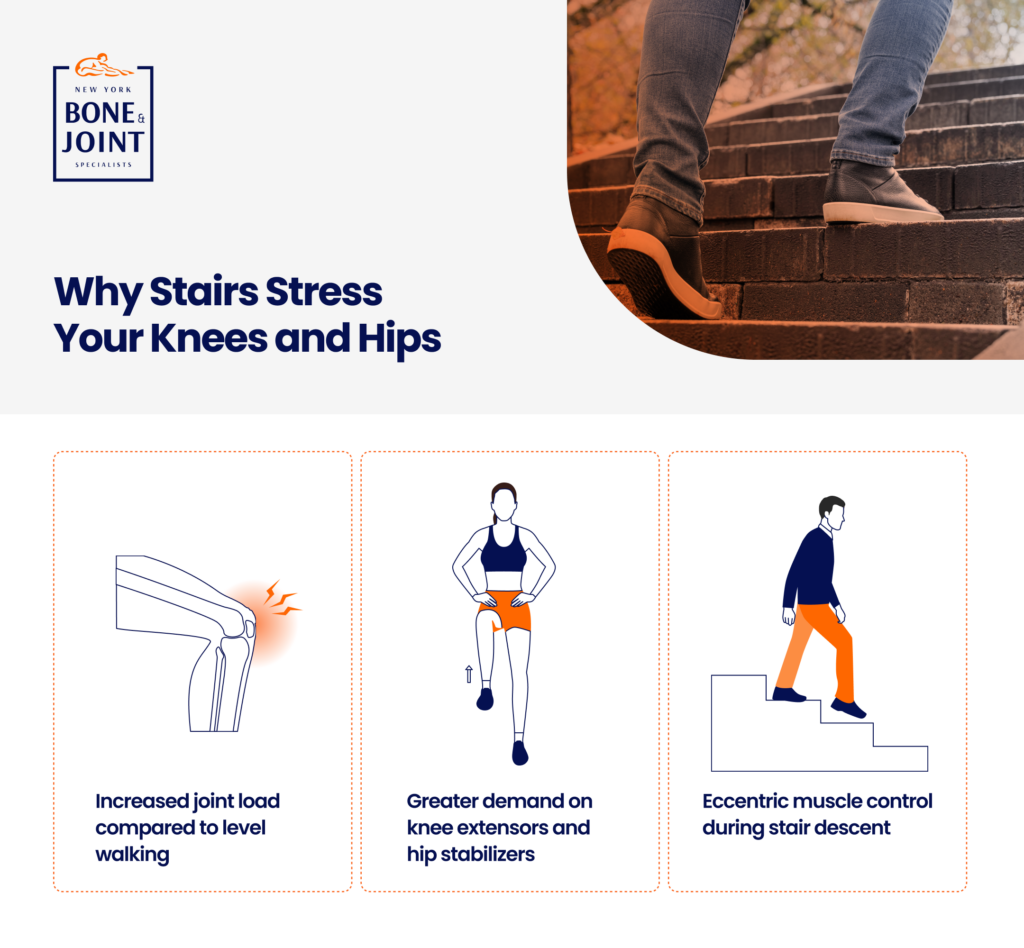
Quite simply, you’re asking your hip and knee joints to do more when climbing stairs. The joints have to move in ways they don’t usually when walking on level ground. This puts more pressure on the joints as they work against gravity. One study found the hip and knee must absorb six to eight times your body when climbing up stairs.
Increased stress on the kneecap. Lifting your body up the stairs requires a deep knee flexion that may put extra stress to the kneecap. On the other hand, the quadriceps lengthen to control your body weight as you descend steps, which also forces more load on the front of the knee.
Biomechanics/muscle imbalance. Leaning forward as you step up the stairs shifts the pressure onto the front of the knee. If the hip or thigh muscles are weak or tight, the knee takes on more of the load. Hip pain when walking up stairs may flare if you lean forward or to one side.
Weak hip flexors. The hip flexors at the front of your hip work hard to lift your leg up the stairs compared to walking on flat pavement. If your hip flexors are inactive from sitting all day, you’ll struggle going up stairs.
Underlying orthopedic condition. Knee or hip pain may be the first sign of an underlying condition in the joint, such as arthritis or bursitis. The pain may not be evident during other activities.
Why Knee Joint Pain Often Shows Up First on Stairs
Knee joint pain climbing stairs typically involves the kneecap, or the patella. A network of muscles, tendons, and ligaments attach the patella to the tibia (shin bone) and femur (thigh bone). The knee joint is lined by a protective layer of cartilage. Early damage or deterioration of the knee joint often shows up as kneecap pain when climbing stairs.
Patellofemoral pain syndrome (FPS). Also known as a patellar pain or runner’s knee, this condition develops when the kneecap misaligns with the trochlea, or groove, in the thigh bone. Bending the knee when going up and down stairs can trigger pain.
Knee chrondromalacia. The cartilage lining the kneecap wears down, often resulting in pain when climbing stairs.
Meniscus tear. The knee has two wedges of cartilage known as the menisci that act as shock absorbers. A torn meniscus usually causes pain when twisting or bending the knee, but it can also flicker when going down steps.
Knee osteoarthritis. The cartilage protecting the knee joint wears down, causing the bones of the joint to rub together. Weight-bearing activities, like climbing stairs, can increase the pain and stiffness of knee arthritis.
What Causes Hip Pain When Going Up or Down Stairs
Pain in the hip joint when climbing stairs usually develops because you’re shifting more of your body weight onto the hip joint when raising the leg. Hip pain usually centers in the front of the joint, and it can be due to a flexor muscle or joint issue.
Hip flexor muscle vs. hip joint pain
- Pain when you lift your leg to reach the next step is related to the hip flexors.
- Pain when you transfer your weight to push up to the next step is likely due to the joint.
Orthopedic conditions related to hip pain when climbing stairs
Hip impingement. Also known as femoroacetabular impingement (FAI), this condition involves a bony growth in the hip joint. Pain may surface when going up or down stairs.
Hip bursitis. The bursa, or a small sac of fluid cushioning the bones and soft tissue of the joint, becomes inflamed and causes pain when climbing stairs.
Labral tear. A tear or irritation in the labrum, a tough sheath of cartilage hugging the hip socket, can make moving up and down stairs difficult.
How the SI Joint and Lower Back Can Contribute to Stair Pain
What feels like hip or knee pain may originate elsewhere in the body. As noted previously, weakened hip or thigh muscles can lead to knee joint pain when climbing stairs. Yet another joint — the sacroiliac joint — could also be the source of your unsteadiness while navigating steps.
The sacroiliac joint, or SI joint, connects the bottom section of your spine (the triangle-shaped sacrum made of fused vertebrae) to the ilium, the top part of your pelvis. Ligaments hold these bones together, allowing you to move and importantly, climb stairs. However, the SI joint cannot function properly if it’s injured or inflamed, and that can lead to severe pain and restricted mobility.
SI joint pain typically radiates from the lower back to the buttocks, hips, and thighs. Notably, SI joint pain intensifies when going up and down stairs.
Early Signs You Shouldn’t Ignore
An aching knee or hip when tackling stairs isn’t a normal part of living in the city. Nor is it an inevitable sign of aging. If every step brings pain or you find yourself searching for the elevator, see an orthopedist to determine the source of the pain.
- Pain worsens every time you take the stairs
- Lingering pain after stair use
- The knee “buckles” or feels unstable
- Unable to reduce swelling with ice and elevation
- Inability to put weight on the joint
- Pain in one hip only
How NYBJ Diagnoses Stair-Related Joint Pain
The expert orthopedists at New York Bone & Joint will take a comprehensive look at your stair-related symptoms to find the true source of the pain.
- A history of when the symptoms started and any patterns
- A physical exam to assess joint mobility
- Movement analysis as walk, step, and squat to spot mechanical deficiencies
- Assess muscle strength in supporting muscles (glutes, quads, hamstrings)
- Imaging to rule out other conditions or when medically necessary
Treatment Options for Stair-Related Joint Pain
Going up and down stairs doesn’t have to be painful for your hip or knee joint. A proper diagnosis and therapy can get you climbing stairs without discomfort. You and your doctor can develop a holistic plan that fits your lifestyle and preferences.
- A physical therapy referral. Ask if targeted physical therapy exercises to strengthen and improve flexibility of the muscles around the joint, such as the hip flexors, quads, hamstrings and glutes, can alleviate joint pain when taking the stairs. Inquire how long a physical therapy program would last.
- Occupational therapy. Working with an occupational therapist can help you improve your stair-climbing mechanics to reduce pain.
- Medication. Discuss with your doctor if medication and/or injections are appropriate for the condition causing the step-related pain.
- Surgical vs. non-surgical. The underlying cause of the hip and knee pain while climbing stairs may be addressed by surgical intervention. Your doctor will outline your surgical options, or if non-surgical methods can successfully treat the issue.
Step Up Without Pain
Even if the pain isn’t felt while walking on level pavement or during other activities, hip or knee pain while going up or down stairs often indicates the joint is under stress and needs a thorough evaluation. The physicians and staff at New York Bone & Joint Specialists have the skills to uncover why your knee or hip aches when climbing stairs and prescribe an effective treatment plan. Contact our office today to step up those steps with no pain.
FAQs
Why do my knees hurt when climbing stairs but not when walking?
Simply because you’re asking more of your knees when you climb stairs. You must bend your knee more sharply, and you’re putting more pressure on the joint as it fights against gravity as you move up the steps.
What causes hip pain when climbing stairs?
Climbing stairs shifts more of your body weight to the hip joint, especially when lifting the leg. It can also be due to weak hip flexor muscles or an underlying condition, such as a labral tear or bursitis.
Is joint pain on stairs a sign of arthritis?
It can be. Arthritis is a gradual deterioration of the cartilage cushioning the bones of the knee joint. This eventually causes friction between the knee bones that can be exacerbated by stair climbing.
Can SI joint pain be triggered by stairs?
Yes. The sacroiliac joint, or SI joint, connects the bottom section of your spine (the triangle-shaped sacrum made of fused vertebrae) to the ilium, the top part of your pelvis. Along with the attached ligaments, this joint makes movement possible. However, the SI joint cannot function properly if it’s injured or inflamed, and that can lead to severe pain and mobility restrictions, particularly when going up and down stairs.
When should I see an orthopedic specialist for stair-related pain?
See an orthopedist if the pain doesn’t go away or seems to worsen. Other signs include persistent swelling, a sensation of instability in the joint, or inability to put weight on the joint.
Our Locations
-

Upper East Side: Full Service Orthopedic Center & Walk-In
1198 3rd Avenue, Between 69th and 70th Street New York, NY 10021Physicians: Monday–Friday 8:00am–6:00pm, Saturday 8:00am–5:00pm
Physical Therapy: Monday–Friday 7:00am–7:30pm, Saturday 8:00am–3:00pm
Sunday: ClosedPhone: (212) 759-4553 -

Orthopedic Doctor Midtown Manhattan NYC — New York Bone & Joint Specialists
425 Madison Ave, Suite 200 (second floor) New York, NY 10017 (corner of East 49th Street)Physician appointments: Mon–Fri 8:00 am–6:00 pm
Physical therapy: Mon–Fri 7 am–7:30 pm, Sat 8 am–3 pmPhone: (212) 759-4553 -

Orthopedic Doctor Upper East Side NYC — New York Bone & Joint Specialists
130 E 67th St New York, NY 10065Currently ClosedPhone: (212) 759-4553