
Millions of people suffer from neck, shoulder, and back pain caused by injuries, muscle strain, disc disease, or even sleeping in an awkward position. Another common but often overlooked culprit is poor posture.
We don’t think about posture much in daily life, but it has a major impact on the musculoskeletal system. When the body is out of alignment, it can cause pain, stiffness, and long-term dysfunction. There are two types of posture to consider—static and dynamic:
- Static posture describes how we hold our bodies while sitting, standing, or sleeping.
- Dynamic posture refers to body positioning while moving, including when walking, bending, or climbing stairs.
Poor posture could be the cause of your chronic back, neck, or shoulder pain. To determine the exact source of your pain, visit the best spine surgeons in New York City at New York Bone & Joint Specialists. Our board-certified spine experts use advanced diagnostic tools and innovative therapies to identify the cause of your pain and create a treatment plan that helps you live pain-free.
Why do posture problems require expert spine care?
Your muscles, tendons, ligaments, and joints all play a role in maintaining alignment and balance. When everything functions properly, these structures distribute pressure evenly and allow flexible movement. But when posture shifts out of alignment, it can lead to pain, stiffness, and even neurological symptoms such as headaches, cognitive fatigue, or nerve compression.
Posture problems can be traced to several factors:
- Structural imbalances. Conditions like scoliosis (a sideways curvature of the spine) or having one leg shorter than the other can alter body alignment and create uneven muscle strain.
- Spinal disc degeneration. As we age, the discs that cushion the vertebrae lose fluid and height, sometimes leading to flatback syndrome, where the lower spine straightens and causes forward leaning and pain when standing.
- Lifestyle habits. Our dependence on technology can affect our posture, highlighted by a condition known as “tech neck.” In fact, a recent study found that many respondents reported using mobile devices while reclining on a sofa or mattress, thereby forcing their spine out of its natural position.
Because back pain can stem from many causes, it’s important to seek the advice of a top-rated spinal surgeon in New York City for an exact diagnosis. The orthopedic team at New York Bone & Joint Specialists combines clinical expertise with advanced imaging to pinpoint the root of the problem and recommend the right treatment.
How do the best spine surgeons in New York approach posture diagnosis?
At New York Bone & Joint Specialists, we take a comprehensive, detailed approach to evaluate spinal conditions and determine whether posture is the root cause of your back, neck, and shoulder pain. At every step of the process, our focus is always on providing the utmost in patient care to ensure your comfort and keep you informed along the way.
We use advanced imaging and functional assessments to evaluate posture and identify the source of pain:
- Imaging tests. X-rays, CT scans, and MRIs can help diagnose spinal conditions, such as degenerative disc disease or scoliosis.
- Movement analysis. One of our spinal specialists in New York will observe how you walk, squat, or reach for objects to detect where you may be straining your muscles or where there may be muscle imbalances.
- Ergonomic assessment. Reviews how you sit, stand, and use devices to uncover habits that strain the spine.
These insights help determine the most effective path forward, whether through therapy, ergonomic adjustments, or, in more complex cases, surgical correction. Our spine surgeons work closely with physical therapists and pain management physicians to ensure comprehensive, coordinated care.
Treatment approaches used by leading NYC spine surgeons
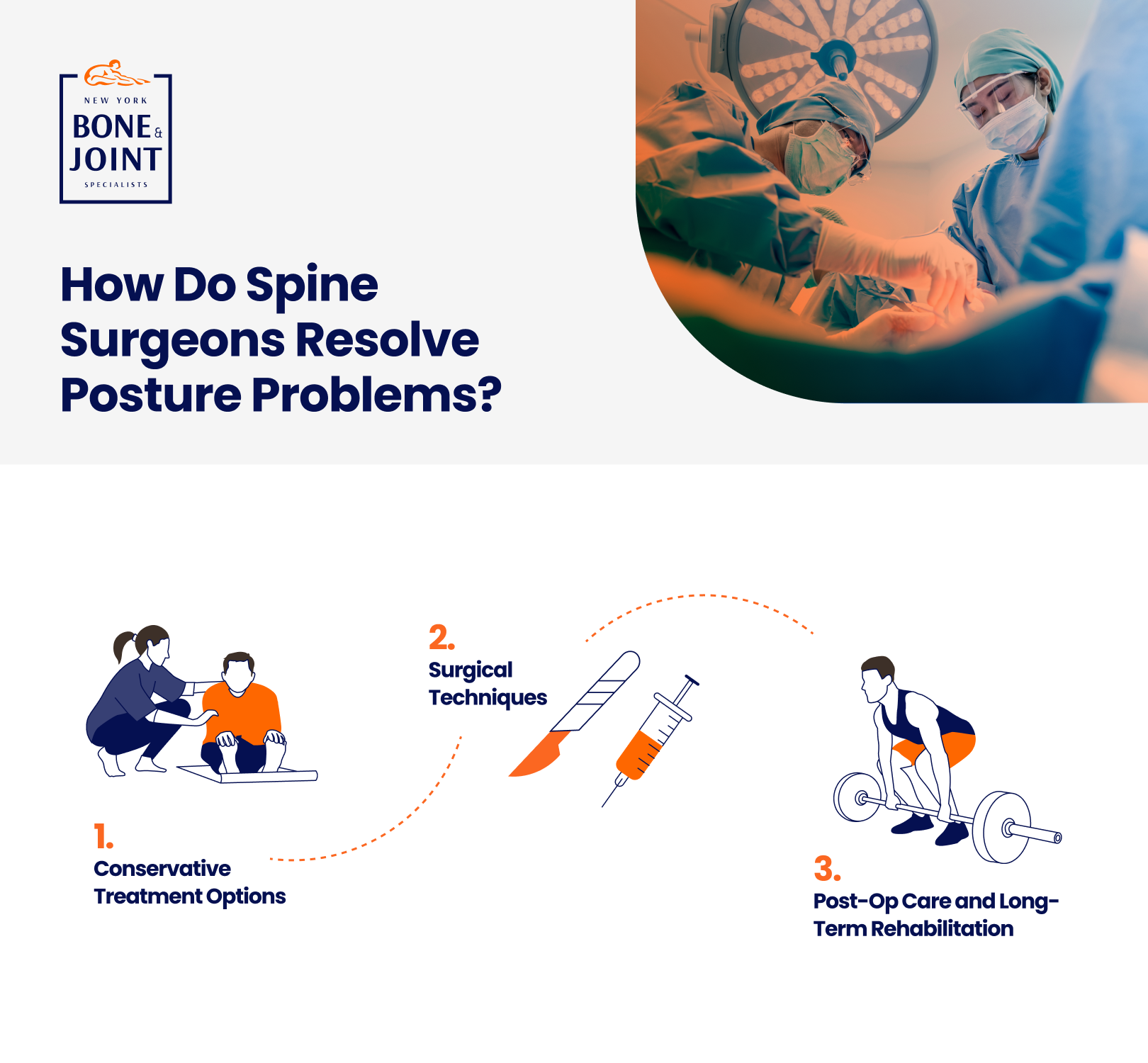
Our spine specialists offer a full spectrum of treatments, from non-invasive therapy to advanced minimally invasive surgery. Care plans are customized to each patient, with an emphasis on restoring strength, alignment, and comfort. During and after treatments, our top-rated spinal therapists will continue to monitor your progress to ensure your full recovery.
Non-surgical treatments
Physical therapy and posture retraining. Physical therapy focused on stretching, lengthening the spine and torso, and building up the core muscles can aid in posture correction. A physical therapist can show you how to do these exercises, but here are two to try at home.
Child’s pose
- Sit on your shins with your knees together, big toes touching, and heels slightly apart.
- Walk your hands forward and fold from your hips, lowering your torso toward the floor.
- Rest your forehead on the mat or turn your head gently to one side.
- Keep your arms extended in front of you or relax them by your sides.
- Breathe deeply into your back and waist, holding for up to 5 minutes.
Cat-cow pose
- Begin on your hands and knees, keeping your weight evenly balanced across all four limbs.
- Inhale as you lift your chest and tailbone, letting your belly drop toward the floor.
- Exhale as you round your spine, drawing your chin gently toward your chest.
- Move smoothly between these two positions with steady, mindful breaths.
- Continue this flow for about 1 to 2 minutes.
Wearable devices. A wearable posture corrector, such as a brace or shoe lifts, can help realign the body when structural imbalances exist.
Mind-body awareness. Not everyone thinks about their posture every minute, but it’s helpful to take a minute or two each day to review your posture. If you feel it’s off, simply lift your head, pull your shoulders back, and tighten your abdominal muscles for a quick correction.
Surgical treatments
When conservative treatments aren’t enough, particularly for structural conditions like advanced scoliosis or disc degeneration, surgery may be the best solution.
Our surgeons specialize in minimally invasive spinal procedures using small incisions and precision tools to reduce pain, scarring, and recovery time.
Examples include:
- Artificial disc replacement. Reserved for disc degeneration cases, the damaged disc is removed through a small incision. A prosthetic “spacer” is then placed between the two vertebrae to stabilize the spine. Most patients recover within weeks.
- Spinal fusion. For severe scoliosis, spinal fusion may be recommended. During the procedure, two or more vertebrae are fused to create a single, stable alignment. Most patients begin walking soon after surgery and can resume light activities within 4–6 weeks, with full recovery typically achieved in 6–12 months.
Following surgery, our physical therapy team guides patients through a rehabilitation program focused on rebuilding strength and maintaining long-term posture health.
How to choose the best spine surgeon for posture issues in NYC
Selecting an experienced, board-certified spine surgeon is essential for effective treatment and recovery.
At New York Bone & Joint Specialists, our team offers:
- Expertise in complex spinal conditions and minimally invasive techniques
- Advanced diagnostic technology for precise evaluation
- A conservative-first philosophy, with most patients improving without surgery
- Integrated physical therapy and recovery programs
- A compassionate, patient-centered approach proven to deliver results
Who to see for poor posture in New York
Everyone’s posture is unique, but chronic discomfort shouldn’t be ignored. However, if you believe your posture may be the root of your back, shoulder, and neck pain, consult with one of the best spine surgeons in New York City at New York Bone & Joint Specialists. We are the top facility in New York City for spine surgery and posture correction.
Our experts will identify the cause, tailor a treatment plan, and help you move through life with better posture and less pain.
Contact us today online or by phone to get started.
FAQs
Who is the number one spine surgeon in New York?
At New York Bone & Joint Specialists, you’ll encounter the best spine surgeons in New York City. Each of our top-rated spinal specialists has undergone extensive training and certification requirements to perform delicate spinal surgery. We also prioritize conservative methods to treat spinal conditions and posture issues.
What is the hardest back surgery to recover from?
Spinal fusion tends to require the longest recovery, though today’s minimally invasive techniques reduce pain and downtime significantly.
Is there surgery to fix bad posture?
It depends on what the cause of bad posture is. Structural issues such as scoliosis and degenerative disc disease can be improved with surgery. If poor posture is the result of sitting incorrectly at your desk or staring down at your smartphone, you’ll benefit from physical therapy and posture retraining.
Can bad spine posture be fixed?
Absolutely. By practicing proper alignment—keeping your head and shoulders stacked over your hips and your feet flat on the floor—you can retrain your posture at any age.
At what age is it too late to fix bad posture?
Posture tends to deteriorate with age. However, physical therapy and postural awareness can help reverse bad posture at any age.