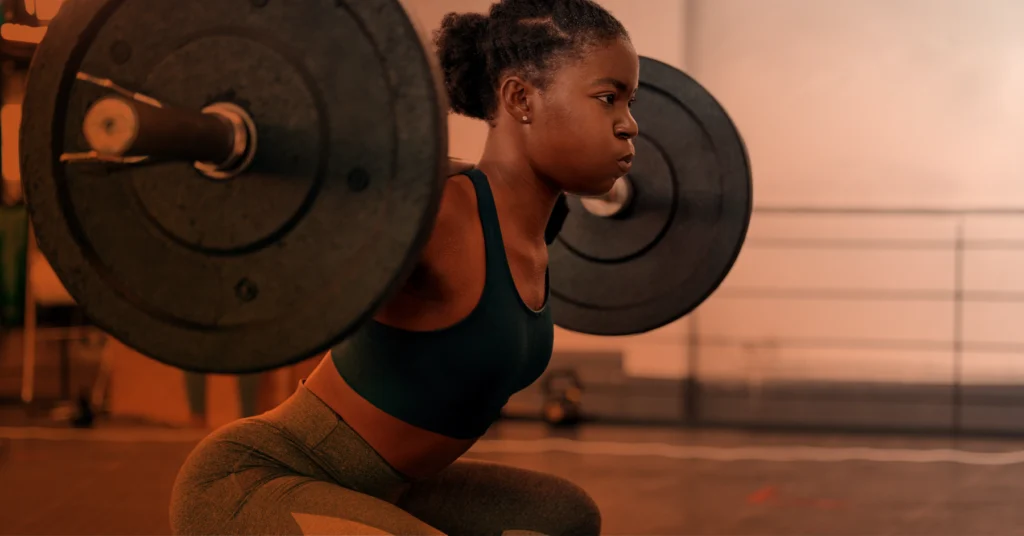
Weightlifting strengthens muscles and bones and is a vital part of a well-rounded fitness routine—but the right form makes a huge impact on effectiveness.
Weightlifting builds muscle, increases bone density, improves stability, and supports everyday movement. It’s especially important for older adults, who naturally lose lean muscle mass over time. Strength training can also help reduce injury risk, improve posture, and support joint health.
The U.S. Department of Health and Human Services recommends 150 minutes of moderate aerobic activity each week, plus strength training at least two times a week.
Before you rush to a gym and start pumping iron, work with a trainer or physical therapist on the proper weightlifting form. Learning the correct techniques will protect your vulnerable joints, tendons, cartilage, and spinal discs from common weightlifting injuries. The right weightlifting mechanics will result in a stronger, healthier you.
What “proper form” means in orthopedics
Proper form isn’t a one-size-fits-all formula. Nor is it copying what the person next to you is doing. A physical therapist or trainer will study your unique anatomy and how well you move. Based on those observations, the PT will model an appropriate weightlifting strategy just for you. Sticking to those mechanics every time you lift will prevent common weightlifting injuries.
Despite individual differences, several common elements go into developing proper form:
- Joint positioning. Aligning major joints (wrists, shoulders, hips, knees, spine) to stabilize your body under load.
- Muscle sequencing. Coordinating muscles to move smoothly and efficiently through each rep.
- Full range of motion. Performing the movement through a safe, controlled range without forcing depth.
- Load distribution. Spreading force across multiple muscles instead of overloading a single joint or tissue.
How poor form leads to orthopedic injuries
If proper form protects you, poor form does the opposite. It often triggers a chain reaction that shifts pressure onto vulnerable joints, tendons, cartilage, or spinal discs. Even strong muscles and bones can break down when the force is repeatedly placed in the wrong areas.
Weightlifting injuries generally fall into two categories.
Acute injuries
These happen suddenly, often from lifting too much weight, moving abruptly, or losing control of the load. Examples include:
- Shoulder dislocation
- Fractures
- Herniated disc injury
- Muscle sprains or strains
- ACL injury from poor squat mechanics
Overuse injuries
These develop gradually from repetitive stress, poor movement patterns, or training too frequently without recovery. Examples include:
- Stress fractures
- Chronic joint pain
- Achilles tendonitis
- Tendon irritation (shoulder, knee, elbow, wrist)
The joint-by-joint consequences of bad form
Weightlifting engages nearly every joint in the body, and that can leave them vulnerable to injury if your mechanics are misaligned.
Shoulders
The shoulder has the greatest range of motion of any joint, which makes it powerful but also vulnerable when stability and alignment are compromised. Exercises like bench presses, overhead presses, and lateral raises can strain the shoulder when elbows flare too wide, the load is uncontrolled, or the shoulder blades aren’t properly supported.
Common shoulder injuries include:
- Shoulder impingement: Tendons become pinched or irritated during overhead motion, often when the shoulder is rolled forward or the movement lacks control.
- Distal clavicular osteolysis (AC joint arthritis): Repetitive stress from pressing movements can cause small fractures and breakdown at the AC joint near the top of the shoulder.
- Labrum or SLAP tear: Damage to the cartilage rim (labrum) that helps stabilize the shoulder, sometimes caused by poor overhead mechanics or heavy pressing with improper alignment.
Spine (neck, thoracic, lower back)
The spine is designed to tolerate load but only when it remains stable and supported. Poor lifting technique often involves rounding or hyperextending the back, especially during deadlifts, squats, overhead lifts, and forward bending movements. When the spine loses its neutral position, pressure shifts to delicate structures like spinal discs and ligaments.
Common spine-related injuries include:
- Herniated disc: The disc between vertebrae can bulge or become inflamed when the spine is repeatedly flexed or loaded in a compromised position.
- Sprains and strains: Ligaments, muscles, or tendons can stretch or tear, especially during heavy lifts performed with poor bracing or unstable posture.
Hips
Many lower-body lifts depend on strong hip mobility and control. When that mobility is limited or when the knees and pelvis don’t track properly, stress can shift to the front of the hip joint. Exercises like squats, lunges, and Olympic lifts may increase injury risk if the hips collapse inward or depth is forced without control.
Common hip injuries include:
- Hip labral tear: A tear in the cartilage that lines the hip socket, often linked to repetitive stress, poor hip mechanics, or twisting under load.
- Hip bursitis: Inflammation of the bursa (a small fluid-filled cushion near the joint), typically caused by repetitive irritation or poor movement patterns.
Knees
Knee injuries are often caused by poor alignment under load, especially when knees collapse inward or shift too far forward during squats. Movements like squats, split squats, sumo squats, and jump landings can overload tendons and ligaments when stability and tracking aren’t controlled.
Common knee injuries include:
- Patellar tendonitis: Repetitive stress on the tendon beneath the kneecap, often caused by frequent bending and poor load distribution.
- ACL and MCL injuries: Ligaments can become strained or torn when knee mechanics are unstable, especially during heavy squats or when knees cave inward during lifting or landing.
Ankles and feet
The feet and ankles play a major role in stability and balance during lifting. When foot mechanics collapse, or when load is repeatedly absorbed through the feet without proper control, tissue irritation can build over time. Exercises like heavy squats, jumping and landing drills, and split squats often increase stress on the Achilles tendon and plantar fascia.
Common ankle and foot injuries include:
- Plantar fasciitis: Inflammation of the thick tissue band under the foot, often caused by repeated pressure and poor foot support.
- Achilles tendonitis: Irritation of the tendon connecting calf to heel, often linked to overuse, poor alignment, or insufficient recovery.
Form protects the “big 3” orthopedic tissues
Bones and muscles aren’t the only parts of your body proper form protects from damage. Using good techniques takes care of your soft tissues, too.
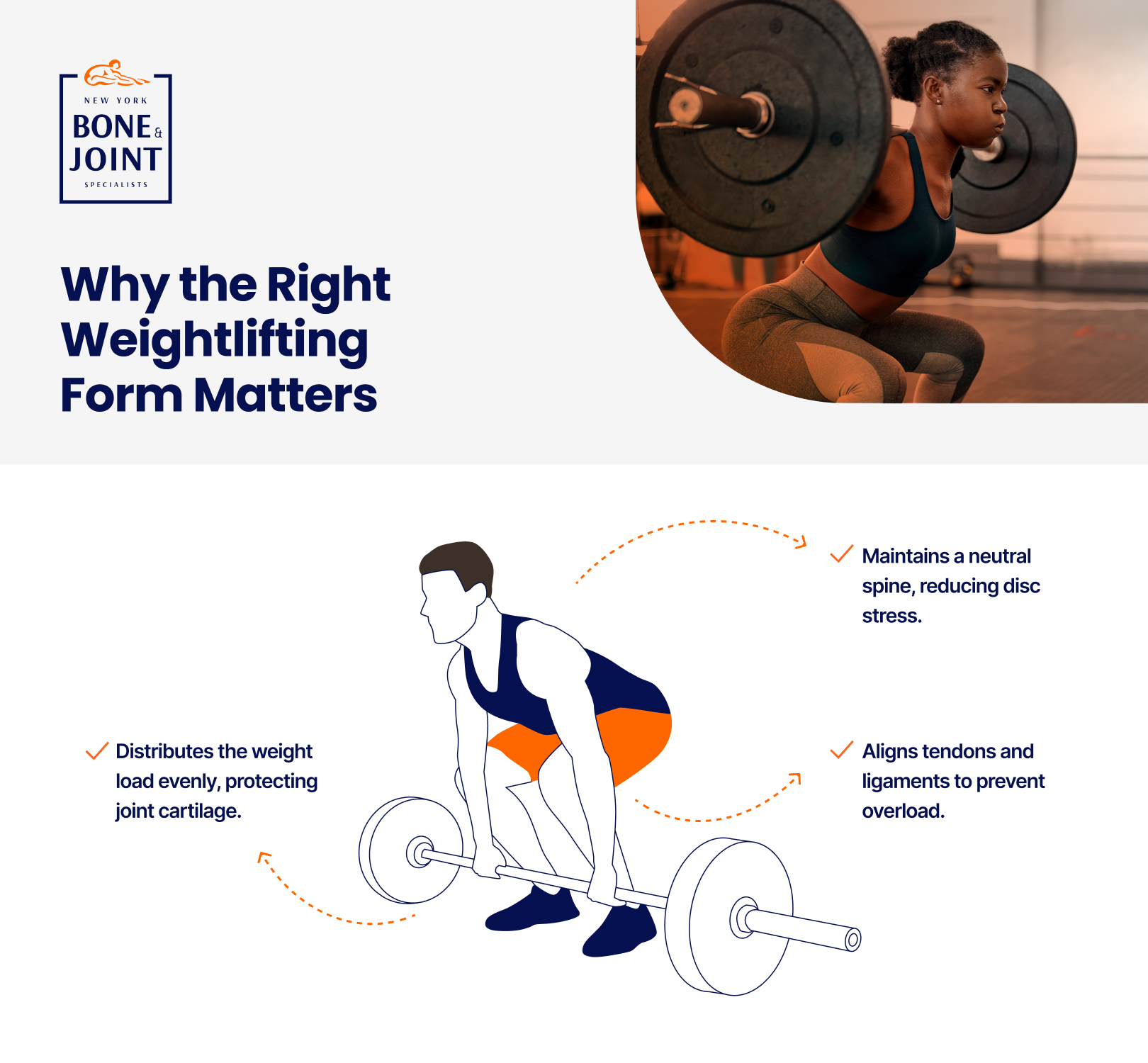
Cartilage. Lifting the correct way spreads the pressure evenly over the strong, connective tissues in your joints. Poor form puts cartilage at risk due to concentrating too much weight on them, eventually leading to wear and tear.
Tendons and ligaments. Tendons connect muscles to bone, while ligaments attach bone to bone. Proper alignment keeps tendons moving smoothly and ligaments from taking on too heavy a load.
Intervertebral discs. Keeping your spine in a neutral position, wearing a weightlifting belt, and following proper form all take the stress off the delicate discs cushioning each vertebrae in the back.
Performance benefits of good form
Learning proper weightlifting techniques will definitely take some time. Once you master the mechanics, you’ll notice a definite upgrade in your performance, including:
- Stronger muscle activation. Engaging targeted muscles will evenly distribute the weight over the joints.
- Safer lifting. Transferring the force of the weight over different parts of the body will help you lift safely and efficiently.
- A better foundation. Building a strong framework at the beginning allows you to progress consistently through the program.
- Injury prevention. Using the proper technique and good posture can prevent setbacks that can derail your fitness goals.
The most common form errors orthopedists see
Practicing good form every time in the gym isn’t always easy. If you find yourself falling into these bad habits, take a breather to reassess your technique. An orthopedist or physical therapy can spot what you may be doing wrong:
Starting with heavy weights. Beginning with too-heavy weights can tire you out and throw your form off-kilter. Slowly increase weight as you progress and grow stronger.
Rushing the reps. Speeding or bouncing through the repetitions means you’re neglecting proper form. Work at a comfortable pace and concentrate on form, not speed.
Poor posture. Rounded shoulders as well as a hyperextended or arched lower spine can lead to injury and pain. Keep your spine neutral and shoulders back and down. Engage your core during the exercise.
Poor knee positioning. Letting your knees collapse inward or move too far forward during squats can wreck your form.
Improper breathing technique. Never hold your breath. Instead, breathe out as you lift the weight and breathe in as you lower the weight.
Not resting between sessions. Give your muscles time to rest and recover between workouts.
The key is to stay within your limits. Don’t force your joints beyond their comfortable range of motion and listen to your body.
What good form looks like in key lifts
Weightlifting involves a number of key movements. Master these first and you can advance to more challenging lifts.
Squats
- Stand with your feet a comfortable distance apart. Toes pointed slightly outward.
- Bend your knees and push your hips back, as if sitting in a chair.
- Keep most of your weight in your heels as you go through the motion.
- Maintain a neutral spine and keep your knees apart.
- Go as far down as comfortable.
- Hold this position while you focus on squeezing your thigh and hip muscles.
- Push through your feet to straighten your knees and return to a standing position.
Deadlifts
- Place the barbell on the floor close in front of you and set your feet hip-width apart.
- Bend over with straight legs and grip the barbell.
- Then lower your hips so that they are parallel to the floor.
- Engage your chest to pull your back into a neutral position.
- Then squeeze your glutes as you rise and remember to maintain a straight back.
- Rise to a standing position and lower the barbell back down in a slow, controlled motion.
Bench Presses
- Lie on the bench with your feet on the floor.
- Un-rack the bar with straight arms.
- Lower it to your mid-chest as you tuck in your elbows at 45-degree angle.
- Press it back up until you’ve locked your elbows.
Overhead Presses
- Stand with feet shoulder-width apart and knees locked. Hands facing forward with thumbs wrapped.
- The bar should rest on your upper chest/front shoulders.
- Keep elbows forward and under the bar. Forearms vertical.
- Tighten abs and glutes and lift chest slightly to create a neutral spine
- Take a deep breath, press the bar vertically overhead in a straight line, moving your head back through the bar as it passes your face.
- Extend arms fully but don’t hyperextend. Biceps should be aligned with your ears, with the barbell directly over your mid-foot/shoulders.
- Move the bar down in a controlled movement, moving your head back into the front rack position.
Pull-ups
- Grab the pull-up bar with your palms down and shoulder-width apart.
- Keep your shoulders back. Don’t roll them forward or squeeze your shoulder-blades.
- Maintain a neutral lower back in a straight line from shoulders to knees. Don’t overarch the lower back.
- Hang onto the pullup-bar with straight arms and your legs off the floor.
- Pull yourself up by pulling your elbows down to the floor.
- Go all the way up until your chin passes the bar.
- Lower yourself until your arms are straight.
Seated cable rows
- Set the appropriate weight on the weight stack and attach a close-grip bar or V-bar to the seated row machine.
- Grasp the bar with a neutral grip (palms facing in).
- Keeping your legs slightly bent and your back straight, pull the weight up slightly off the stack.
- Start by sitting upright with your shoulders back.
- Keeping your body in position, pull the handle into your stomach.
- Pull your shoulder blades back, squeeze, pause, and then slowly lower the weight back to the starting position.
How to build safe form over time
Perfecting your form is an ongoing process, and it will take practice. Progress gradually and you’ll find proper form comes naturally.
Warmup. Warm up for five to 10 minutes before lifting.
Start with lighter loads. Find a weight you can lift comfortably 12 to 15 times. Increase the weight when you feel stronger. If a weight fatigues you after 10 reps, lighten the weight.
Lift slowly. Gradually move through the lift. Take about two seconds to lift the weight and four or more seconds to lower the weight.
Improve mobility. Note where your movements are restricted (ankles, hips, thoracic spine, shoulders) and focus on increasing mobility in those areas.
Strengthen stabilizers. Target the glutes, core muscles, rotator cuff, and foot or ankle to stabilize your body as you move through the lift.
Get coaching and feedback. Work with a trainer or physical therapist. How-to videos are a great source of step-by-step guidance, too. Film yourself and ask for feedback from a professional.
Don’t overdo it. Manage your load smartly and in increments. Resist the temptation to do another set of reps when you’re fatigued. Rest and wait for the next session to start up again.
When pain is a warning sign
Your body sends signals through pain. Don’t ignore those signs. But how do you know if it’s “good” soreness or “bad” pain? Here’s the difference:
Delayed onset muscle soreness (DOMS)
This soreness results from small tears in the muscles that eventually repair and make them stronger. It’s normal after a workout and usually goes away in a few days. Your movements shouldn’t be restricted by muscle soreness.
Pain
Pain is more intense and longer lasting than muscle soreness. The pain radiates from a specific body part, like a joint or tendon, and continues for more than 48 to 72 hours. Other symptoms such as swelling, numbness, tingling, or a catching/locking sensation in a joint may be present. Persistent pain usually indicates an injury and requires immediate medical evaluation and treatment. However, you can avoid a serious injury by constantly perfecting and making adjustments in your form.
Start your weightlifting journey with us
Weight training boosts muscle strength, increases bone mass, and supports long-term health. But those benefits depend on one key factor: proper form.
Correct mechanics protect your joints, spine, and soft tissue and help you gain strength more efficiently. Like any skill, good lifting technique takes practice and adjustment, but the payoff is worth it.
The physicians at New York Bone & Joint Specialists can help you train safely and address any potential sources of pain you may be experiencing. Schedule an appointment with us today to learn more about keeping your muscles and joints safe while adopting a new weightlifting routine.
FAQs
What’s the difference between good soreness and an injury?
Soreness after an intense workout is normal. It’s actually healthy and means your muscles are healing and getting stronger. Persistent pain and other symptoms may be red flags for a joint injury or soft tissue damage. Go to an orthopedist for a thorough evaluation if the pain persists.
Is it normal to feel lifting in my joints instead of my muscles?
Actually, no. Your joints and muscles should work together when lifting. If you feel more strain in one over the other, you may be putting too much force on the joints and not the muscles. This imbalance is usually caused by poor form and could lead to injury.
How heavy should I lift before my form is perfect?
There is no specific weight threshold. Form should be trained from the start, even with bodyweight or light resistance. Once you can perform a movement consistently with control, you can gradually increase load.
Do I need a coach or physical therapist to fix my form?
We recommend it. A professional can spot issues you may not notice, provide personalized cues, and help you avoid injury, especially if you’ve had pain or previous injuries.
Which lifts cause the most orthopedic injuries?
One study linked squats and deadlifts to the highest rates of injury. Injuries occurred most often in the back and shoulder. Proper form can greatly reduce the chance of an injury.