Bursitis Treatment and Bursitis Specialists
Written by: Dr. Popovitz.
Board-Certified Orthopedic Surgeon | Fellowship-Trained Sports Medicine, NYU Langone Medical Center | FAAOS
Co-Founder, NY Bone & Joint Specialists | Lenox Hill Hospital - Northwell Health
Recognized: New York Magazine Best Doctor | New York Times Super Doctor | IAOS Leading Physician of the World | IAOS Top Orthopedic Surgeon in New York
Date Published: October 4, 2018
Last Updated: August 11, 2025
Last Medically Reviewed: August 11, 2025
This page has been written and reviewed by a fellowship-trained, board-certified orthopedic surgeon with over 20 years of clinical experience. All clinical claims are supported by peer-reviewed literature and current AAOS and AOSSM guidelines. See References section below.
Book a consultation
Prompt Appointments Available
Upper East Side: 1198 Third Ave | Midtown: 425 Madison Ave
Surgery performed at Lenox Hill Hospital - Northwell Health
Our joints are able to do all the things we need them to do with the help of a support system of tendons, ligaments, and muscles. Another element in that network are small, fluid-filled sacs called bursae. Your body contains 150 bursae, with each bursa cushioning the tendons, muscles, and skin near your bony joints.
Mostly due to overuse from repetitive motions, the bursae can become inflamed and lead to bursitis, a painful joint condition. Bursitis can strike any joint in the body, but most often affects the hip, shoulder, elbow, and knee. In addition to pain, bursitis can severely restrict movement in those joints.
If you think you have hip bursitis or shoulder bursitis, see one of the bursitis doctors at New York Bone & Joint Specialists. Bursitis symptoms are similar to other orthopedic conditions, so getting an accurate diagnosis is vital. The expert orthopedists at New York Bone & Joint Specialists have the diagnostic skills to make the correct diagnosis of bursitis and help you on the road to recovery. Fortunately, conservative treatments, such as hip bursitis exercises, bring relief in nearly all bursitis cases.
What is Bursitis? Understanding Bursa Inflammation
Bursitis is an inflammation of one or more of the bursae, and typically strikes the hip, shoulder, elbow, and knee joints. A common medical condition, bursitis, will affect the majority of Americans at least once in their lifetime. Yet some people may be prone to bursitis due to several risk factors:
Age: Bursitis is more common in people over 40.
Sports: Sports that entail repetitive motions, such as throwing a baseball, long-distance running, or golfing.
Occupation: Carpenters, carpet layers, or workers who lift heavy objects.
Hobbies: Gardening, painting, and playing a musical instrument.
Medical conditions: Gout, rheumatoid arthritis, and diabetes.
Mechanical factors: Having one leg shorter than the other.
Injury: A direct blow to the bursa sac.
Infection: Staphylococcus aureus bacteria can sometimes cause bursitis. An infected bursa is rare but can be treated with antibiotics.
Rest and at-home treatment can heal bursitis in a few weeks. However, if not fully healed, bursitis can become chronic and you’ll experience repeated flare-ups. The bursae will develop more damage and further restrict the joint’s range of motion.
Bursitis Symptoms and Diagnosis
Bursitis symptoms will vary depending upon which joint it affects. Yet there are distinct bursitis signs:
- Aching pain
- Pain that intensifies when moving the affected joint
- Limited range of motion in the joint
- Swelling around the joint
If bursitis is caused by an infection:
- Red or discolored skin around the joint
- The skin feels warm
- You have a fever
See a doctor if you experience:
- Sudden or shooting pain when exercising or engaging the joint
- Severe or disabling joint pain
- Inability to move the joint
- Fever
- Excessive swelling, redness, or a rash in the affected area
Diagnosis
A bursitis specialist will make a diagnosis of bursitis by:
- Examining the affected joint for pain points
- Asking about your health history and when the pain started
- Ordering imaging tests (X-ray, MRI) to rule out other conditions and detect swollen bursae
- Requesting lab tests (blood test, analysis of the bursa fluid obtained through a needle aspiration) to determine if there is an infection
Bursitis vs. Tendonitis
Bursitis presents similar characteristics as tendonitis. Both are painful conditions caused by repetitive motions. However, tendonitis is an inflammation of the tendons—pieces of connective tissue between muscles and bones. It can be acute or chronic. Meanwhile, bursitis is an inflammation in one or more of the bursae in the tissues near the joints.
Arthritis vs. Bursitis
Both conditions affect the joints, but there are key differences. Bursitis is typically a short-term inflammation of the bursa due to excessive stress on the joint. Arthritis is a degeneration of the cartilage in the joints and is a chronic condition requiring long-term management.
Hip Bursitis: Trochanteric and Ischial Bursitis
The hip joint connects the thigh bone to the pelvis. The pointed upper, outside edge of the femur is termed the greater trochanter. Bursitis develops in one of the bursae covering the greater trochanter.
Symptoms of trochanteric bursitis:
- Pain along the outside of the hip, the side of your upper thigh, and buttocks
- Pain when lying on the affected side
- Pain after standing or sitting for extended periods
- Pain that worsens when moving the hip, such as walking up stairs
Causes:
- Repetitive motions (lifting heavy items, cycling, running)
- Injury to the hip from falling or playing sports
- Health conditions such as bone spurs and scoliosis
- One leg is shorter than the other
- Calcium deposits in the tendons attached to the hip
- The iliotibial (IT) band rubs against the bursa in the greater trochanter due to repetitive motions
Ischial Bursitis
Ischial bursitis is an inflammation of the bursae in the “sit” bones, the U-shaped bones at the bottom of your pelvis. The leading cause is pressure on the bursae due to prolonged sitting on hard surfaces or activities like driving, cycling, or horseback riding.
Symptoms:
- A dull ache in the buttocks or the back of the thighs
- Pain aggravated by prolonged sitting
- The area is tender to the touch
Bursitis develops less commonly in the iliopsoas bursa located on the inside (groin side) of the hip. When this bursa becomes inflamed, the pain radiates to the groin area.
Hip Bursitis Exercises: Therapeutic Movement and Stretching
Physical therapy for hip bursitis can be beneficial in reducing pain by gently stretching the muscles around the joint. Work with a physical therapist to achieve the proper form and progress slowly.
Iliotibial band (IT) stretch
- Stand a few inches from a wall, with your affected hip toward the wall. If you feel unsteady, hold on to a chair.
- Stand on the leg with the affected hip. Then cross your other leg in front of it.
- Let your affected hip drop out to the side of your body and against the wall. Then lean away from your affected hip until you feel a stretch. You can take the arm that’s against the wall and raise it over your head as you lean away from your hip.
- Hold the stretch for 15 to 30 seconds.
- Repeat 2 to 4 times.
- Repeat on the other hip.
IT band roller stretch (Word of caution: go slowly and stop if pain increases.)
- Position a foam roller at the bottom of your outer right thigh. Use your arms to support your upper body.
- Stack your legs so your left leg is on top of your right.
- Bend your left leg and set your left foot down in front of your right leg.
- Using your arms and left leg to hold your weight, roll your outer thigh up and down the foam roller from the outside of your knee to your outer hip.
Ilioposas/Hip flexor half kneeling stretch
You can perform this with a folded towel under your knee or on a yoga mat.
- Kneel on the floor with your left foot flat in front of you and your right knee on the floor behind you.
- Keep your trunk tall during this exercise. You can keep your hands on your left knee for balance.
- Gently slide your right knee back until you feel a small stretch in the front of your hip.
- Squeeze your right glute like you are pushing forward, bringing your trunk and hips toward your left foot. Tuck your hips slightly, creating a pelvic tilt.
- Take a deep breath and hold this pose for 10–30 seconds.
Clamshell for glute strengthening
- Lie on your side and bend your knees to a 45-degree angle. Keep your hips, knees, and ankles stacked on top of each other.
- Pull your belly button toward your spine to engage your core.
- Slowly lift your top knee, keeping your feet together. Don’t let your hips roll backward.
- Hold at the top for 5-10 seconds before slowly lowering your leg to the starting position.
- Complete 15-20 reps on each side.
Piriformis stretch (from straight legs)
- Lie on your back with your legs straight.
- Lift your affected leg and bend your knee.
- With your opposite hand, gently pull your knee toward your opposite shoulder. You should feel the stretch in your buttock and hip.
- Hold the stretch for 15 to 30 seconds.
- Repeat 2 to 4 times.
- Repeat with your other leg.
Lower abdominal (core) strengthening
- Lie on your back with your knees bent and your feet flat on the floor.
- Tighten your abdominal muscles by pulling your belly button in toward your spine. Keep breathing normally and don’t hold your breath.
- Lift one foot off the floor and bring your knee toward your chest, so that your knee is straight above your hip and your leg is bent like the letter “L.”
- Lift the other knee up to the same position.
- Lower one leg at a time to the starting position.
- Alternate legs until you have lifted each leg 8 to 12 times.
Exercises to avoid with hip bursitis
- Deep squats
- Lunges.
- Leg presses
- High-impact aerobics (running, jumping jacks)
- Movements involving sudden and aggressive leg movements.
Shoulder Bursitis: Subacromial and Subdeltoid Inflammation
Your shoulder contains bursae that can become inflamed and lead to shoulder bursitis. It’s different from shoulder impingement, which is an irritation of the rotator cuff tendons. However, both conditions may be present in some cases.
The bursitis can be located in two areas of the joint:
Subacromial: The bursae in the area between your rotator cuff and the acromion, the highest point of your scapula or shoulder blade.
Subdeltoid: The bursae between the deltoid muscle and the shoulder joint.
Causes
- Repetitive overhead motions (weightlifting, throwing a baseball, swinging a hammer)
- Poor posture
- Trauma to the shoulder (fall, sudden blow to the shoulder)
- Infection in the bursa
- Underlying condition (arthritis, rotator cuff tear or impingement)
Symptoms
- Chronic pain
- Pain that increases when sleeping on the affected shoulder
- Swelling
- Stiffness
- Reduced range of motion (cannot move the shoulder without pain)
- Tenderness
If caused by an infection in the bursa:
- Discoloration or redness
- A feeling of heat or warmth
Treatment for Shoulder Bursitis
- Rest from any activity that strains the shoulder
- Icing the joint
- Over-the-counter pain relievers and nonsteroidal anti-inflammatory medications
- Prescription corticosteroids either taken orally or via injection
- Antibiotics for an infection
- Physical therapy to improve mobility and strength in the shoulder muscles
One exercise to try is a posterior shoulder stretch:
- Stand and relax your shoulders. Hold the elbow of your affected arm with your other hand.
- Use your hand to pull your affected arm gently up and across your body. You will feel a gentle stretch across the back of your affected shoulder.
- Hold for at least 15 to 30 seconds, then slowly lower your arm.
- Repeat 2 to 4 times.
- Repeat on your other shoulder.
Other Common Types of Bursitis
Bursitis can develop in other parts of the body, such as:
Elbow bursitis (olecranon bursitis) is an inflammation in the bursae located at the bony tip of the elbow (the olecranon). It can be caused by leaning on the elbow for long periods or infections. Swelling and pain are common symptoms. Treatment centers on pain medication, wearing elbow pads, or splints to keep the joint straight.
Knee bursitis can occur in three areas around the knee:
- Prepatellar in the front of the kneecap
- Infrapatellar below the kneecap
- Pes anserine bursitis on the inner side of the knee
All three cause pain, swelling, and tenderness, particularly with activity. Knee movement may be restricted. Repetitive motions, trauma, and other conditions (arthritis, diabetes) can result in knee bursitis. Treatment involves rest, ice therapy, pain relievers, corticosteroids, and physical therapy.
Heel bursitis is an inflammation of the bursae in the heel, leading to pain and tenderness. Pain intensifies when standing on your toes. Typically caused by intense running and jumping, or too-tight shoes, heel bursitis can be treated with rest, icing, pain medication, and orthotics.
Hand and wrist bursitis is caused by inflamed bursae in the hand or wrist. Symptoms include pain that worsens when putting weight on the hand or wrist or bending the wrist backward. Commonly seen among individuals who support their weight with their hands and wrists, such as cyclists, rest, ice therapy, compression with a sleeve or bandage, and nonsteroidal anti-inflammatory medications are effective treatments for this type of bursitis. Ultrasound therapy may also be prescribed.
Conservative Treatment Options for Bursitis
Bursitis usually resolves on its own without any specific treatment. However, you can speed up your recovery and reduce pain with conservative therapy, which reportedly has a success rate of 90 percent.
- Rest from any activity that aggravates joint pain
- Apply ice three times a day for 15 minutes to reduce swelling
- Apply a heating pad or other dry heat source to increase blood flow and promote healing
- Take over-the-counter nonsteroidal anti-inflammatory drugs (NSAIDs), such as ibuprofen or naproxen, to reduce inflammation in the bursa
- Elevate the painful joint
- Wear a splint, brace, or sling to relieve pressure on the joint
- Physical therapy to increase range of motion in the joint and strengthen muscles surrounding it
- Occupational therapy to show you ways to move that don’t stress the joint
- Wear kneepads if you kneel all day for work
- Take breaks from repetitive tasks or when seated for long periods
- Lift heavy objects using the strength in your legs, not your back, hips, or shoulders. Bend at the knees and wear a knee brace for extra support
Advanced Treatment Options for Bursitis
If rest and conservative therapies fail to bring pain relief, advanced techniques are an option.
Corticosteroid injections: An injection of a corticosteroid into the bursa can quickly relieve inflammation. However, the number of shots may be limited.
Platelet-rich plasma therapy: Platelet-rich plasma (PRP) therapy uses the patient’s own blood to extract platelets, which are injected into the painful joint to stimulate healing. The injection is guided by ultrasound. Reduction in pain and improved joint function can be achieved in two to six weeks.
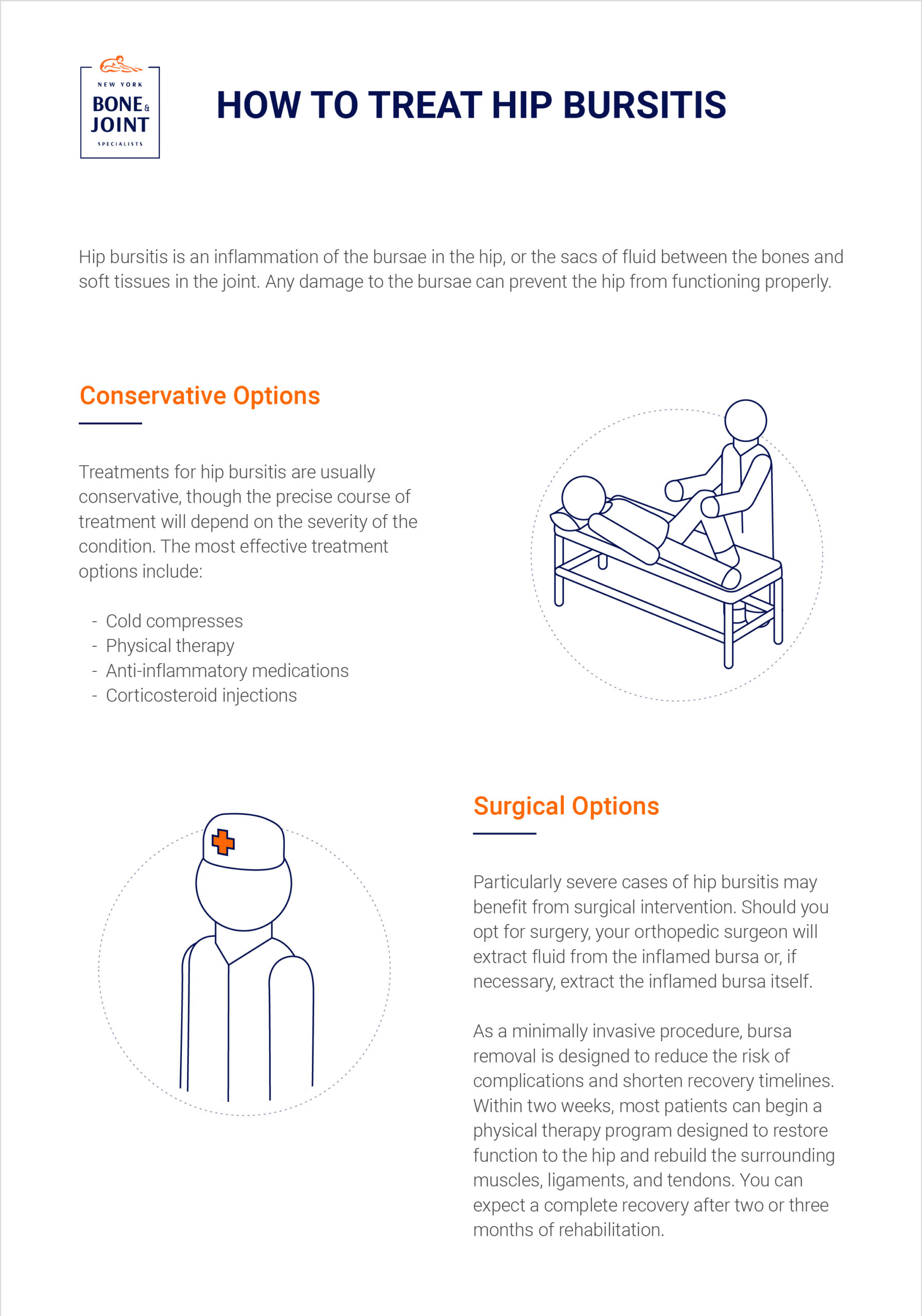
Surgery: In rare cases, surgery (bursectomy) to drain or remove the inflamed bursa may be recommended. The muscles and joints are not affected if the bursa is removed. Surgery can provide immediate relief from pain and swelling. After surgery, you may use an assistive device (brace, sling, crutches) for a week or two to keep your body weight off the recovering joint.
One study found the success rate for trochanteric hip surgery ranged between 88 percent and 100 percent.
Potential complications include stiffness and reduced range of motion in the joint after a bursectomy, along with bleeding, infection, and allergic reaction to the anesthesia. However, these are rare. Physical therapy is recommended after the surgery to regain full mobility, which may take weeks or months.
Why Choose New York Bone & Joint Specialists for Bursitis in NYC?
For decades, New Yorkers have put their trust in us for effective bursitis treatment. Our prominence in the field is a testament to our unwavering commitment to patient well-being and successful outcomes.
- Comprehensive & Compassionate Care: Our world-class specialists offer expert and empathetic guidance at every stage, from accurate diagnosis to thorough rehabilitation.
- Prioritizing Joint Health: We recognize the vital role healthy joints play in an active and fulfilling life. Your joint health and lasting healing are our foremost concerns.
- Effective Minimally Invasive Solutions: We successfully address a wide range of bursitis issues using advanced orthopedic treatments, frequently employing minimally invasive techniques.
- Dedicated to Full Recovery: We are committed to your complete recovery, always prioritizing conservative methods and only recommending expert surgical intervention when absolutely necessary.
New York Bone & Joint Specialists: Leaders in Bursitis Treatment
At New York Bone & Joint Specialists, we prioritize the preservation of your body’s natural structures, a critical element for successful bursitis recovery. Our dedication to superior care ensures that a remarkable 90% of our patients achieve full recovery without the need for surgery, guaranteeing lasting health, optimal function, and peace of mind.
Make an appointment today
Ready to take the first step toward relief? Schedule an appointment with New York Bone & Joint Specialists and start your personalized recovery plan today.
Frequently Asked Questions About Bursitis
Please answer four or five of the following questions.
What type of doctor should I see for bursitis?
Depending upon the exact cause, bursitis can be treated by orthopedists for structural joint issues causing the bursitis or sports medicine doctors if the bursitis is related to a sporting activity (such as running or weightlifting). A rheumatologist can treat bursitis if it’s caused by an inflammatory condition like arthritis or rheumatoid arthritis. Physical therapists can help patients learn exercises and movement modifications to reduce pain and stiffness.
How do I find a qualified bursitis specialist?
Search for a bursitis specialist near you. Make sure they have credentials in orthopedics as well as advanced training in treating bursitis and other musculoskeletal conditions. Ask about their treatment philosophy: Do they focus on conservative methods? When would they recommend surgery?
How is shoulder bursitis different from rotator cuff injury?
A rotator cuff tear or strain is caused by an inflammation or rupture in the tendons (the rotator cuff) holding the shoulder joint together. Shoulder bursitis is an inflammation of the bursae sacs near the joint. Both conditions may be present in the joint at the same time. A bursitis specialist or orthopedist can make an accurate diagnosis.
When should I see a bursitis doctor?
Bursitis usually resolves in a few weeks with at-home care (OTC medication, icing) and rest. But if the pain lingers or you cannot move the shoulder or hip without intense pain, see a bursitis doctor for further evaluation. He or she can recommend non-surgical therapies, such as a corticosteroid shot or physical therapy.
Can bursitis be cured permanently?
Nearly all cases of bursitis can be cured with at-home care, rest, and non-surgical treatments. But if the inflammation is not fully healed and you continue activities that stress the joint, you may experience repeated flare-ups. That’s why it’s important to see a physical therapist for treatment.
Is bursitis the same as arthritis?
No, arthritis is a degeneration of the cartilage in the joints and is chronic. Bursitis is an inflammation of the bursae near the joints and is usually short-lived.
How do I prevent bursitis from coming back?
To prevent bursitis and its recurrence:
- Take frequent breaks from repetitive tasks.
- Maintain a healthy weight.
- Exercise to strengthen the muscles around the joint.
- Warm up and stretch before working out.
- Use supportive devices, such as knee pads if you kneel for work.
Doctors Seeing Patients for Hip Conditions:






Medically Reviewed by Dr. Popovitz.
You can book your appointment with New York Bone & Joint online by submitting the appointment request form here:
Book an appointmentOur Locations
-

Upper East Side: Full Service Orthopedic Center & Walk-In
1198 3rd Avenue, Between 69th and 70th Street New York, NY 10021Monday–Friday: 9:00am–6:00pm
Saturday: 8:00am–5:00pm
Sunday: ClosedPhone: (212) 759-4553 -

Orthopedic Doctor Midtown Manhattan NYC — New York Bone & Joint Specialists
425 Madison Ave, Suite 200 (second floor) New York, NY 10017 (corner of East 49th Street)Physician appointments: Mon–Fri 8:00 am–6:00 pm
Physical therapy: Mon–Fri 7 am–7 pm, Sat 8 am–2 pmPhone: (212) 759-4553 -

Orthopedic Doctor Upper East Side NYC — New York Bone & Joint Specialists
130 E 67th St New York, NY 10065Tuesday & Thursday: 8:00am–6:00pm
All other days: ClosedPhone: (212) 759-4553