Elbow Arthroscopy or Arthroscopic Surgery
Written by: Dr. Popovitz.
Board-Certified Orthopedic Surgeon | Fellowship-Trained Sports Medicine, NYU Langone Medical Center | FAAOS
Co-Founder, NY Bone & Joint Specialists | Lenox Hill Hospital - Northwell Health
Recognized: New York Magazine Best Doctor | New York Times Super Doctor | IAOS Leading Physician of the World | IAOS Top Orthopedic Surgeon in New York
Date Published: October 15, 2018
Last Updated: March 13, 2025
Last Medically Reviewed: March 13, 2025
This page has been written and reviewed by a fellowship-trained, board-certified orthopedic surgeon with over 20 years of clinical experience. All clinical claims are supported by peer-reviewed literature and current AAOS and AOSSM guidelines. See References section below.
PT Staff
Aayushi Chavda, PT | Cecilia Manubay, PT | Hetali Patel, PT | Nishtha Sharma, PT | Riddhi Patel, DPT | Samay Patel, PT, DPT
Book a consultation
Prompt Appointments Available
Upper East Side: 1198 Third Ave | Midtown: 425 Madison Ave
Surgery performed at Lenox Hill Hospital - Northwell Health
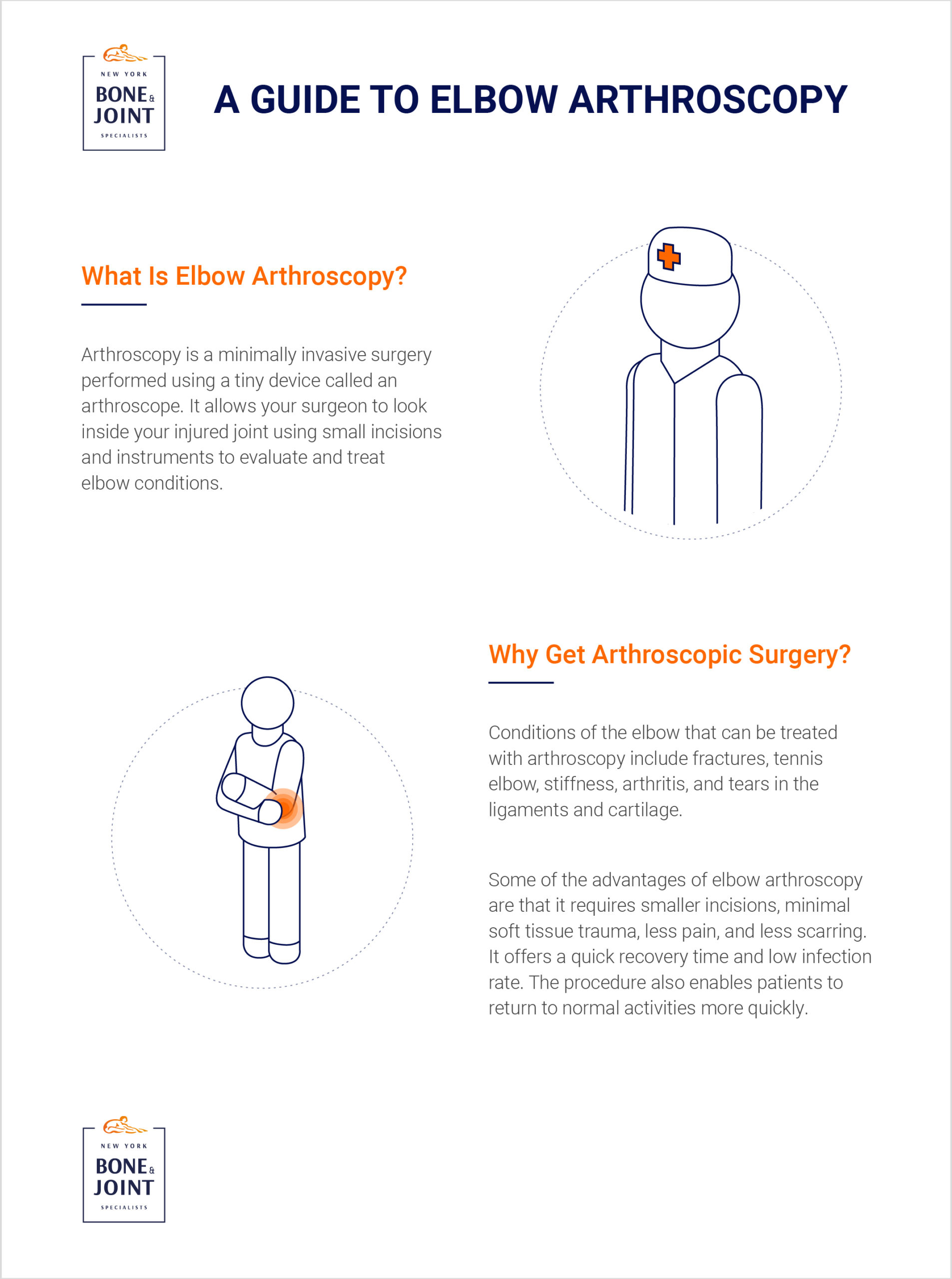
The elbow is the joint that connects the upper arm bone and the forearm bones. The joint may be affected by inflammation, injury, or other conditions causing severe pain and requiring surgical treatment. Arthroscopy is a minimally invasive surgery performed using a tiny device called an arthroscope.
INDICATIONS
Conditions of the elbow that can be treated by arthroscopy include fractures, tennis elbow, stiffness, arthritis, and tear in the ligaments and cartilage.
DIAGNOSIS
Your orthopedic surgeon performs a physical examination and seeks your medical history before arthroscopy is performed.
PROCEDURE
Elbow arthroscopy is a minimally invasive surgery or keyhole procedure that allows your surgeon to look inside the joint using small incisions and instruments to evaluate and treat elbow conditions. It is performed under anesthesia. To perform the procedure, your surgeon will make 2-3 incisions near your elbow. One is for the insertion of an arthroscope, a small device with a camera and lens fixed to the end of a narrow fibre-optic tube, and the other is for the insertion of operating instruments.
AFTER SURGERY
After the surgery, your surgeon will place a cast or a splint that prevents the movement of the elbow until it is healed completely. You should elevate the elbow to avoid swelling and minimize pain. Ice (wrapped over a cloth) can be applied over the operated area which helps to reduce swelling. Medications are prescribed to reduce pain.
ADVANTAGES
Some of the advantages of arthroscopy are it requires smaller incisions, minimal soft tissue trauma, less pain, faster recovery time, low infection rate, less scarring, and earlier mobilization. It also allows patients to return to normal activities more quickly.
RISKS AND COMPLICATIONS
Some of the risks observed after elbow arthroscopy include infection, damage to the nearby nerves or tissues during surgery, and stiffness which can be treated through occupational therapy. Exercises are performed to strengthen and rebuild elbow muscles.
Elbow arthroscopic surgery may not be performed in individuals with ulnar nerve transposition and in those who had undergone previous surgery that changed the normal elbow anatomy.
SYMPTOMS & CONDITIONS
Orthopedists at New York Bone & Joint are highly skilled in treating numerous sports injuries, including:
- Understanding Shoulder Dislocations: Types, Causes, and Treatments
- Shoulder Pain or Neck Pain? How to Tell the Difference | Expert Advice from Dr. Leon Popovitz & Dr. Michael Mizhiritsky
- 5 Ways to Celebrate National Physical Fitness and Sports Month
- 10 Easy Orthopedic Exercises for Joint Health and Mobility
- How Sports Medicine Improves Quality of Life
- 4 Reasons to See a Sports Medicine Doctor
- Why Rest Days Are Important
- 6 Signs You Should See a Doctor for Your Sports Injury
- Debunking the Myth of “Training Through the Pain”: Why You Shouldn’t Ignore a Sports Injury
- An Orthopedic Surgeon Addresses the “Age-Old” Question: How Old Is Too Old to Participate in Competitive Sports?
- QB Deshaun Watson Suffers ACL Tear: What Does It Mean?
- How To Treat Hip Flexor Strains
- SLAP Tears: Overuse Sports Injuries of The Shoulder
- The Long-Term Effects of Youth Sports
- The Truth About Knee Pain
- New Study Shows Some Meniscus Tears May Not Require Surgery
- When Is It Time To Hang It Up? – The Aging Athlete
- A Doctor’s Letter On Sharapova – To The New York Times
- Warriors’ Andrew Bogut Uncertain For Game 6
- Is Running Bad For The Knees?
- Ready To Exercise?
- Dr. Mizhiritsky Featured in Thrillist Article on Cupping
- What Is The Colorful Tape Olympic Athletes Are Wearing?
- Shoulder Injury Forces Serena Williams to Withdraw from Western and Southern Open
- Mets’ Left Hander Steven Matz Moved to DL with Shoulder Injury
Medically Reviewed by Dr. Popovitz.
You can book your appointment with New York Bone & Joint online by submitting the appointment request form here:
Book an appointmentOur Locations
-

Upper East Side: Full Service Orthopedic Center & Walk-In
1198 3rd Avenue, Between 69th and 70th Street New York, NY 10021Physicians: Monday–Friday 8:00am–6:00pm, Saturday 8:00am–5:00pm
Physical Therapy: Monday–Friday 7:00am–7:30pm, Saturday 8:00am–3:00pm
Sunday: ClosedPhone: (212) 759-4553 -

Orthopedic Doctor Midtown Manhattan NYC — New York Bone & Joint Specialists
425 Madison Ave, Suite 200 (second floor) New York, NY 10017 (corner of East 49th Street)Physician appointments: Mon–Fri 8:00 am–6:00 pm
Physical therapy: Mon–Fri 7 am–7:30 pm, Sat 8 am–3 pmPhone: (212) 759-4553 -

Orthopedic Doctor Upper East Side NYC — New York Bone & Joint Specialists
130 E 67th St New York, NY 10065Currently ClosedPhone: (212) 759-4553