Osteochondritis dissecans is a rare but serious condition that, left untreated, can lead to bone death. Early treatment from an orthopedic surgeon is vital.
Joint pain and stiffness are the first signs of osteochondritis dissecans, but without early diagnosis and treatment, the condition may progress to more severe symptoms. At New York Bone & Joint Specialists, our expert orthopedic surgeons are among the city’s best doctors. We understand how painful and concerning osteochondritis dissecans (OCD) can be, and we work with you to start immediate treatment aimed at healing the break and getting you back to full fitness.
Let’s find out more about this rare condition and what causes cartilage damage.
Understanding Osteochondritis Dissecans: When Cartilage and Bone Separate
Joints form where two bones meet. Articular cartilage, a smooth substance that lines and protects the ends of bones, enables joint movement and absorbs shock during activity. Osteochondritis dissecans occurs when a segment of cartilage and the underlying bone loses its blood supply, causing the tissue to soften, crack, and potentially separate from the surrounding healthy bone.
As this process develops, the affected area can no longer properly support the stresses of joint movement. This damage can result in significant pain and swelling in the affected joint, limiting its normal range of function. In advanced cases, pieces of bone and cartilage may break loose, creating “loose bodies” that can cause the joint to lock or catch.
This condition can affect any joint, but it most commonly occurs in the knee, followed by the ankle and elbow. The knee’s medial femoral condyle (the inner, rounded end of the thighbone) is the most frequently affected area, particularly the weight-bearing surface where the most stress occurs during daily activities and sports.
Where It Most Commonly Strikes
In the knee: The condition typically develops on the medial femoral condyle, the rounded end of the thighbone on the inside of the knee joint. This area bears significant weight during walking, running, and jumping activities.
In the ankle: Osteochondritis dissecans affects the talus, the small bone that sits between the shinbone and the heel bone. This can cause pain with weight-bearing activities and sports participation.
In the elbow: For young athletes involved in throwing sports or repetitive overhead motions, osteochondritis dissecans can develop in the capitellum, a rounded portion of the upper arm bone on the outside of the elbow.
Risk factors and causes
While experts have not identified a single definitive cause of osteochondritis dissecans, several risk factors have been identified:
- Repetitive stress: Repeated minor trauma or stress to joints that may disrupt blood flow to bone segments
- Gender: Males are affected more frequently than females
- Age: Most common in adolescents and young adults with developing bones
- Sports participation: Activities involving repetitive joint motions, jumping, or throwing
- Genetics: Some families show a higher incidence, suggesting a possible genetic component
New York City parents whose children participate in youth sports programs should be aware of persistent joint pain that could indicate osteochondritis dissecans. The good news is that in many children and adolescents, the condition may heal naturally with proper treatment as their bones continue to grow and develop.
Young adults involved in intense training or sports face a higher risk of the bone and cartilage fragment becoming completely detached, which may require surgical intervention.
Osteochondritis Dissecans Symptoms: Recognizing Joint Problems Early
Osteochondritis dissecans symptoms often develop gradually and may be mistaken for other common sports injuries. Early recognition is crucial for successful treatment.
Early Symptoms:
- Vague joint pain during activity (such as throwing a ball, climbing stairs, or putting weight on the ankle)
- Mild swelling and tenderness after exercise or activity
- Intermittent joint stiffness, especially after periods of rest
- Pain that improves with rest and worsens with activity
Progressive Symptoms:
- Persistent joint pain that occurs even with light activity
- Increased swelling that doesn’t resolve with rest
- Joint popping, clicking, or catching sensations
- Episodes of joint locking or feeling “stuck”
- Decreased range of motion and function in the joint
- Joint weakness or a feeling that the joint is “giving out”
- Pain that interferes with daily activities and sports participation
Osteochondritis dissecans is classified in stages defined by whether the cartilage is partially or completely detached from the underlying bone.
- Stage I: A stable lesion with a continuous area covered by soft cartilage.
- Stage 2: A stable lesion with partial displacement.
- Stage 3: A lesion with complete continuity that is not yet dislocated.
- Stage 4: An unstable lesion with a displaced fragment.
Early stages between 1 and 2 benefit from conservative therapy. Later stages may require surgery.
Comprehensive Osteochondritis Dissecans Diagnosis
Accurate diagnosis of osteochondritis dissecans requires a thorough evaluation by an experienced orthopedic specialist. At New York Bone & Joint Specialists, our comprehensive diagnostic approach ensures we identify the condition early and develop the most effective treatment plan.
Clinical Examination
Our specialists will:
- Review your symptoms, including when they began and what activities trigger pain
- Examine the affected joint for areas of swelling, tenderness, and warmth
- Check for any loose fragments or catching within the joint
- Assess the range of motion compared to the unaffected joint
- Perform specific tests, such as the Wilson test for knee OCD, to identify characteristic pain patterns
- Evaluate joint stability and function during movement
Advanced Imaging Studies
- X-rays: Initial imaging to identify bone abnormalities and assess the severity of the lesion
- MRI: Provides detailed visualization of both soft tissue and bone, helping determine lesion stability and the condition of surrounding cartilage
- CT scan: Offers precise bone detail and can identify loose fragments
- Arthroscopy: In some cases, direct visualization inside the joint may be necessary for definitive diagnosis and treatment planning
Osteochondritis Dissecans Treatment: Preserving Your Joint Health
At New York Bone & Joint Specialists, our primary goal is to preserve your long-term joint health while effectively treating osteochondritis dissecans. We follow a conservative-first treatment philosophy, advancing to surgical options only when necessary for optimal outcomes.
Conservative Treatment (First-Line for Stable Lesions)
Most cases of osteochondritis dissecans, particularly in younger patients with stable lesions, respond well to non-surgical treatment:
Rest and Activity Modification
- Temporary cessation of activities that cause joint pain
- May require stopping sports participation for 6-12 weeks or longer
- Gradual return to activity as symptoms improve
Joint Protection
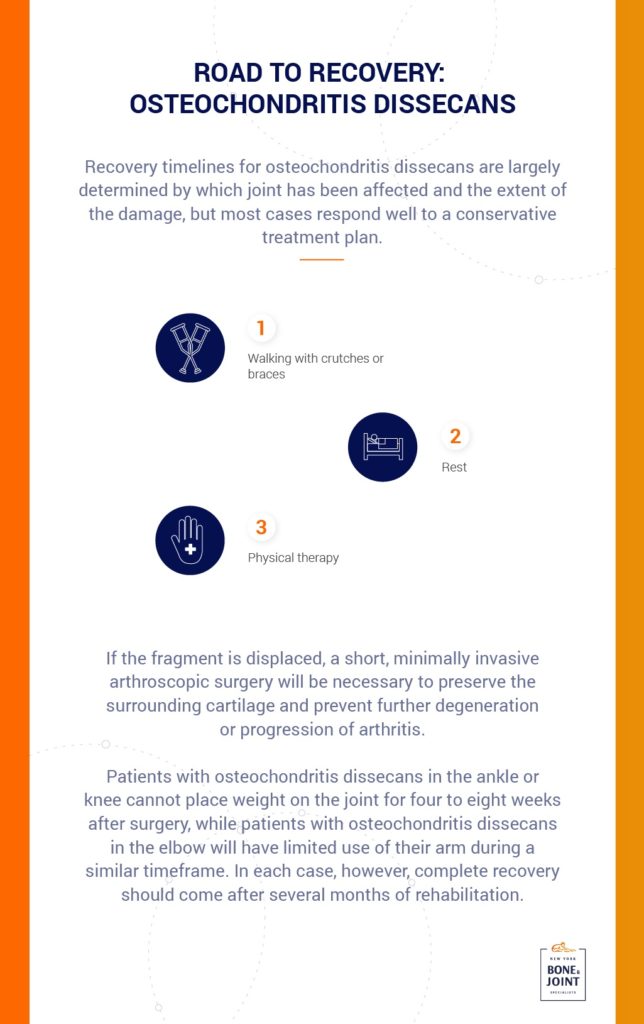
- Use of crutches to reduce weight-bearing on affected lower extremity joints
- Bracing or splinting to limit joint movement and protect healing tissue
- Cast immobilization in some cases to ensure complete rest
Physical Therapy
- Gentle range of motion exercises to maintain joint flexibility
- Progressive strengthening of muscles around the affected joint
- Proprioception and balance training to improve joint stability
- Gradual return-to-activity protocols
Medications
- Over-the-counter anti-inflammatory medications to reduce pain and swelling
- Acetaminophen for pain relief when anti-inflammatories are not appropriate
Monitoring and Follow-Up
- Regular imaging to assess healing progress
- Gradual increase in activity levels based on symptoms and imaging findings
- Long-term monitoring to ensure complete healing
Children and adolescents often heal completely within 3-6 months with conservative treatment, as their bones have excellent healing potential. Adult patients may require longer treatment periods but can still achieve good outcomes with proper care.
Surgical Treatment Options
Some osteochondritis dissecans cases may require surgery if these conditions are present:
- Nonsurgical treatment fails to relieve pain and swelling
- The lesion detaches from the surrounding bone and cartilage
- The lesion is considered unstable
- A large lesion greater than 1 centimeter in diameter
- Bone or cartilage fragment in the joint
- Progressive loss of joint function
- A lesion is in a teen nearing the end of the growth spurt
Arthroscopic procedures:
- Drilling. A series of small holes are drilled into the bone to stimulate growth of new bone.
- Arthroscopic knee debridement. The surgeon removes loose bodies in the joint and smooths rough tissue or cartilage.
- Fragment fixation. The loose fragments are secured with pins and screws to promote healing.
Advanced surgical techniques:
Osteochondral autograft transplantation (OATS). The damaged bone or cartilage is replaced with healthy tissue from another part of the body, such as the other side of the knee.
Osteochondral allograft transplantation. Healthy cartilage pieces from non-weight-bearing areas of the joint are transplanted onto the damaged areas of the joint, allowing the newly implanted bone and cartilage to grow in the affected area. Grafts may be taken from the same individual (auto graft) or from a donor or bone bank (allograft).
Autologous chondrocyte implantation (ACI). Healthy cartilage cells from the non-weight-bearing parts of the joint of the patient are harvested and cultured in a laboratory. The cultured cartilage tissue is implanted in the damaged area to spur new cartilage regeneration.
Recovery and Rehabilitation
Recovery from osteochondritis dissecans varies significantly based on the location of the lesion, treatment method, and individual factors.
Knee Recovery
- Conservative treatment: 3-6 months with gradual return to activities
- After surgery: 6-8 weeks of limited weight-bearing, followed by 3-4 months of progressive rehabilitation
- Return to sports: Typically 4-6 months after surgery, depending on healing and functional recovery
Elbow Recovery
- Conservative treatment: 2-4 months with activity modification
- After surgery: Arm immobilization for 2-4 weeks, followed by gradual motion and strengthening
- Return to throwing sports: 4-6 months with proper rehabilitation
Ankle Recovery
- Conservative treatment: 3-6 months with protected weight-bearing
- After surgery: 4-8 weeks non-weight-bearing, followed by progressive rehabilitation
- Return to full activity: 4-6 months, depending on healing progression
Throughout recovery, our integrated physical therapy team works closely with patients to ensure optimal outcomes and a safe return to desired activities.
Osteochondritis Dissecans in Young Athletes: Special Considerations
Osteochondritis dissecans most commonly affects young athletes between ages of 12-19, making special considerations essential for this population.
Unique Factors in Young Athletes
- Growth potential: Open growth plates provide better healing capacity
- Activity demands: High-level sports participation requires careful return-to-play decisions
- Long-term implications: Decisions made during treatment can affect lifelong joint health
- Psychological impact: Time away from sports can be emotionally challenging
Prevention Strategies for Young Athletes
- Proper training progression: Gradual increases in training intensity and volume
- Cross-training: Varying activities to reduce repetitive stress on any single joint
- Adequate rest: Ensuring proper recovery time between training sessions
- Nutrition and hydration: Supporting optimal bone and cartilage health
- Early intervention: Addressing joint pain promptly rather than “playing through” symptoms
Prevention of Osteochondritis Dissecans
While osteochondritis dissecans cannot always be prevented due to its unclear causes and potential genetic factors, several strategies can reduce risk:
- Avoid overspecialization: Participating in multiple sports rather than year-round single-sport training
- Proper conditioning: Building strength and flexibility in muscles around joints
- Technique training: Learning proper movement patterns to reduce joint stress
- Equipment maintenance: Ensuring playing surfaces and equipment are in good condition
- Professional guidance: Working with qualified coaches and trainers
General Prevention Strategies
- Gradual activity increases: Avoiding sudden jumps in training intensity or duration
- Rest and recovery: Allowing adequate time for tissue healing between activities
- Early intervention: Seeking evaluation for persistent joint pain
- Maintaining fitness: Regular exercise to support joint health and stability
New York City offers excellent resources for athletes, including sports medicine facilities, qualified trainers, and specialized programs that can help reduce injury risk while maximizing performance.
Why Choose New York Bone & Joint Specialists for Osteochondritis Dissecans
As the city’s premier orthopedic and sports medicine center, New York Bone & Joint Specialists provides the best care for osteochondritis dissecans.
- Board-certified orthopedic specialists with expertise in cartilage conditions
- Experience in treating pediatric and adult osteochondritis dissecans
- Advanced arthroscopic and cartilage restoration techniques
- Comprehensive diagnostic imaging capabilities
Frequently Asked Questions About Osteochondritis Dissecans
What exactly is osteochondritis dissecans, and how serious is it?
Osteochondritis dissecans is a condition in which a piece of cartilage and the underlying bone lose their blood supply, causing the cartilage to soften and potentially separate from the joint surface.
While it’s a serious condition that requires proper treatment, most cases can be successfully managed, especially when caught early. In young patients with stable lesions, conservative treatment is successful in most cases. Even when surgery is needed, modern techniques offer excellent outcomes. The key is early diagnosis and appropriate treatment to prevent long-term joint problems.
How can I tell if my joint pain might be osteochondritis dissecans?
Osteochondritis dissecans typically causes deep, aching joint pain that worsens with activity and improves with rest. Unlike a simple sprain or strain, the pain tends to persist and may be accompanied by swelling, stiffness, and eventually catching or locking sensations in the joint.
The pain is usually located in specific areas: the inner side of the knee, the ankle when bearing weight, or the elbow with throwing motions. If you’re a young athlete or active adult experiencing persistent joint pain that doesn’t improve with rest after a few days, it’s important to see an orthopedic specialist for evaluation.
Will I need surgery for osteochondritis dissecans?
Most cases of osteochondritis dissecans can be treated successfully without surgery, especially in children and adolescents with stable lesions. Conservative treatment, including rest, activity modification, and physical therapy, is successful in most stable cases. Surgery is typically recommended only when conservative treatment fails after 4-6 months, when the lesion becomes unstable or displaced, or when loose fragments are causing mechanical symptoms like locking. Your orthopedic surgeon will determine the best approach based on your age, the size and location of the lesion, and your activity goals.
How long does it take to recover from osteochondritis dissecans?
Recovery time varies significantly based on the location of the lesion, your age, and whether surgical treatment is needed. With conservative treatment, many young patients see improvement within 6-12 weeks and complete healing within 3-6 months.
If surgery is required, recovery typically takes 4-6 months for return to full activity, though this can vary by procedure type and individual healing. Knee lesions generally take longer to heal than elbow lesions due to weight-bearing demands. Your doctor will provide specific timeline expectations based on your individual situation and monitor your progress with regular follow-up appointments.
Can osteochondritis dissecans come back after treatment?
When properly treated, osteochondritis dissecans rarely recurs in the same location. However, some patients may be at higher risk for developing new lesions in other areas, particularly if there are underlying genetic factors or if they return to high-impact activities without proper conditioning.
The key to preventing recurrence is following your treatment plan completely, maintaining good joint health through appropriate exercise and activity modification, and having regular follow-up with your orthopedic specialist. Most patients who complete their treatment and rehabilitation successfully can return to their desired activities without problems.
Experiencing joint pain or concerned about osteochondritis dissecans? Our specialists are here to help.
Book an appointment with New York Bone & Joint Specialists to discuss your condition. We’ll schedule an appointment at a time and location that works for you, and send you a reminder by email. Don’t let joint pain keep you from the activities you love – early treatment leads to the best outcomes.