Do You Really Need Rotator Cuff Surgery? An Orthopedic Surgeon’s Guide to Knowing When Surgery Is (and Isn’t) Necessary
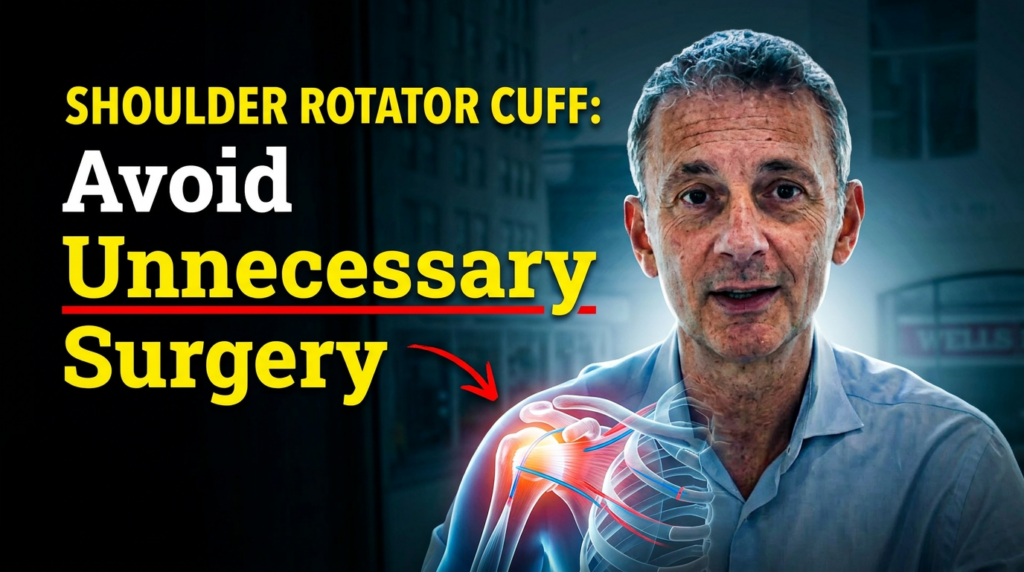
Rotator cuff surgery is one of the most common orthopedic procedures performed today—but according to orthopedic surgeon Dr. Leon Popovitz, it’s also one of the most misunderstood.
Not every rotator cuff tear requires surgery. In fact, many patients can successfully manage certain tears with conservative treatment, while others need prompt surgical repair to prevent permanent damage.
We sat down with Dr. Leon Popovitz, orthopedic surgeon and co-founder of New York Bone & Joint Specialists, to answer the most common questions patients have about rotator cuff tears and when surgery is truly necessary.
What Is the Rotator Cuff?
The rotator cuff is a group of four muscles and tendons that stabilize the shoulder and allow you to lift and rotate your arm.
These four muscles include:
-Supraspinatus
-Infraspinatus
-Teres Minor
-Subscapularis
Together, they work to keep the shoulder stable while allowing smooth, pain-free movement.
Which Rotator Cuff Tendon Tears Most Often?
According to Dr. Popovitz, the supraspinatus tendon is by far the tendon that tears most frequently.
This tendon sits at the top of the shoulder and is responsible for lifting the arm overhead.
Over time, repetitive overhead activities or the development of bone spurs can cause the tendon to rub against the acromion (the bone above the shoulder), gradually wearing it down.
Traumatic injuries, such as falling directly onto the shoulder, can also cause the supraspinatus tendon to tear.
Are All Rotator Cuff Tears Surgical?
No.
One of the biggest misconceptions patients have is believing that every rotator cuff tear automatically requires surgery.
Dr. Popovitz explains that treatment depends on several important factors, including:
Age
Activity level
How the injury occurred
Degree of weakness
Tear size
Whether the tear is traumatic or degenerative
Every patient should be evaluated individually before deciding on surgery.
What Is the Difference Between a Traumatic Tear and a Degenerative Tear?
Traumatic Tears
These tears usually occur in younger, active patients after an injury such as:
Falling
Lifting something heavy
Sports injuries
Sudden trauma
These tears often continue to enlarge over time.
Without repair, the tendon may retract, shrink, and eventually become impossible to repair.
For this reason, younger patients with traumatic tears—especially those experiencing weakness—often benefit from prompt surgical treatment.
Degenerative Tears
Degenerative tears develop gradually over many years.
They are commonly caused by:
Repetitive overhead work
Bone spur formation
Age-related wear and tear
These tears frequently occur in older adults and often respond well to non-surgical treatment, particularly when significant weakness is absent.
Does a Full-Thickness Rotator Cuff Tear Always Mean Surgery?
Not necessarily.
Although a full-thickness tear sounds alarming, surgery is not automatically required.
Older patients who have:
Minimal pain
Good shoulder function
Little or no weakness
may successfully manage even some full-thickness tears through conservative treatment.
The decision depends on how the shoulder functions—not simply what appears on an MRI.
What About Partial Rotator Cuff Tears?
Partial-thickness tears are often excellent candidates for non-operative treatment.
Treatment options may include:
Physical therapy
Activity modification
Anti-inflammatory medications
Cortisone injections (when appropriate)
Regenerative medicine therapies
Because the tendon has not completely torn through, many patients experience significant improvement without surgery.
What Symptoms Suggest Surgery May Be Necessary?
One of the most important symptoms Dr. Popovitz evaluates is weakness.
Pain alone does not necessarily mean surgery is needed.
However, when patients experience:
Difficulty lifting the arm
Significant weakness
Loss of shoulder function
Progressive worsening after an injury
The likelihood that surgery will be beneficial increases considerably.
Can a Rotator Cuff Tear Become Irreparable?
Yes.
This is one of the reasons Dr. Popovitz emphasizes careful monitoring.
When a completely torn tendon is left untreated for too long, it may begin to:
Retract away from the bone
Shrink
Develop fatty degeneration
Lose its ability to heal
Eventually, there may no longer be enough healthy tendon to repair.
This is particularly important in younger patients with traumatic injuries.
Can You Tell Which Tendon Is Torn Based on Symptoms?
Not always.
While certain patterns of weakness can provide clues, symptoms alone usually cannot identify exactly which rotator cuff tendon has been injured.
A thorough physical examination combined with imaging studies helps determine the specific diagnosis.
What Is an Asymptomatic Rotator Cuff Tear?
An asymptomatic tear is a rotator cuff tear that causes little or no pain.
Some tears are discovered incidentally when an MRI is performed for another reason.
Others become asymptomatic after successful conservative treatment.
Even if patients feel well, these tears should still be monitored periodically to ensure they are not progressing.
What Non-Surgical Treatments Are Available?
Many patients improve without surgery.
Treatment options include:
Physical Therapy
Strengthening surrounding muscles often improves shoulder function while reducing pain.
Cortisone Injections
For persistent inflammation, one or two cortisone injections may provide meaningful relief.
Dr. Popovitz generally recommends limiting cortisone injections because repeated injections may interfere with future tendon healing if surgery becomes necessary.
Regenerative Medicine
For selected patients with partial tears or smaller injuries, regenerative medicine may be an option.
These treatments may include:
Platelet-Rich Plasma (PRP)
Bone marrow concentrate (stem cell-based therapies)
These techniques aim to promote the body’s natural healing response while avoiding surgery whenever appropriate.
How Often Should Rotator Cuff Tears Be Monitored?
Patients treated non-operatively should not simply disappear after their symptoms improve.
Dr. Popovitz typically follows patients periodically to ensure:
Symptoms remain controlled
Weakness does not develop
The tear is not enlarging
Function remains stable
Follow-up intervals may gradually increase if patients continue doing well.
When Should You Get a Second Opinion?
Dr. Popovitz encourages patients to seek additional opinions whenever they feel uncertain.
His advice is simple:
Find a physician you trust.
If you’re uncomfortable with a recommendation for surgery—or unsure whether surgery is truly necessary—there is nothing wrong with obtaining a second or even third opinion before making a decision.
The Bottom Line
Rotator cuff surgery can be life-changing for the right patient.
However, surgery is not the correct answer for every tear.
The best treatment depends on:
Your age
Your symptoms
Your activity level
The type of tear
The presence or absence of weakness
Whether the injury was traumatic or degenerative
At New York Bone & Joint Specialists, Dr. Leon Popovitz believes in preserving healthy tissue whenever possible and recommending surgery only when it offers the best long-term outcome.
If you’re experiencing shoulder pain or have been diagnosed with a rotator cuff tear, schedule an evaluation with Dr. Leon Popovitz to discuss all of your treatment options and determine the approach that’s right for you.
Our Locations
-

Upper East Side: Full Service Orthopedic Center & Walk-In
1198 3rd Avenue, Between 69th and 70th Street New York, NY 10021Physicians: Monday–Friday 8:00am–6:00pm, Saturday 8:00am–5:00pm
Physical Therapy: Monday–Friday 7:00am–7:30pm, Saturday 8:00am–3:00pm
Sunday: ClosedPhone: (212) 759-4553 -

Orthopedic Doctor Midtown Manhattan NYC — New York Bone & Joint Specialists
425 Madison Ave, Suite 200 (second floor) New York, NY 10017 (corner of East 49th Street)Physician appointments: Mon–Fri 8:00 am–6:00 pm
Physical therapy: Mon–Fri 7 am–7:30 pm, Sat 8 am–3 pmPhone: (212) 759-4553 -

Orthopedic Doctor Upper East Side NYC — New York Bone & Joint Specialists
130 E 67th St New York, NY 10065Currently ClosedPhone: (212) 759-4553