Physical Therapy NYC
Written by: Dr. Popovitz.
Board-Certified Orthopedic Surgeon | Fellowship-Trained Sports Medicine, NYU Langone Medical Center | FAAOS
Co-Founder, NY Bone & Joint Specialists | Lenox Hill Hospital - Northwell Health
Recognized: New York Magazine Best Doctor | New York Times Super Doctor | IAOS Leading Physician of the World | IAOS Top Orthopedic Surgeon in New York
Date Published: May 4, 2026
Last Updated: October 15, 2026
Last Medically Reviewed: October 15, 2026
This page has been written and reviewed by a fellowship-trained, board-certified orthopedic surgeon with over 20 years of clinical experience. All clinical claims are supported by peer-reviewed literature and current AAOS and AOSSM guidelines. See References section below.
From the Co-Founders
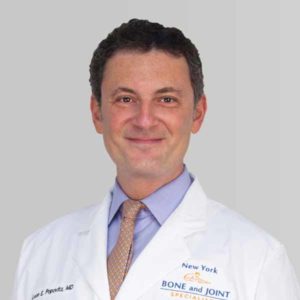
Leon E. Popovitz, MD
Board-Certified Orthopedic Surgeon (ABOS)
Physical therapy is not what happens after your treatment at NYBJ. It is part of your treatment. When I perform a rotator cuff repair or an ACL reconstruction or a meniscus repair, the rehabilitation protocol is not an afterthought hand off to whoever the patient chooses to see. It is a clinical plan that begins in the operating room – where I am thinking about the tension of the repair, the integrity of the tissue, and the specific parameters that will govern how aggressively the joint can be loaded in the weeks that follow. That plan only works if the physical therapist who executes it knows exactly what was done and why.
That is why NYBJ has its own physical therapy department, in the same center as the physicians. Not because it is convenient – though it is – but because the clinical quality of your recovery depends on it. Your PT reads my operative report before your first session.
When questions arise in week three that weren’t anticipated in week one, the answer comes that day, not after a phone tag chain between practices that have never met.

Michael Y. Mizhiritsky, MD
Physiatrist — Physical Medicine & Rehabilitation
The interface between physiatry and physical therapy is where some of the most important diagnostic work in musculoskeletal medicine happens. A patient with neck pain, arm numbness, and weakness may look like a PT case on the surface. An EMG and nerve conduction study tells us whether there is nerve injury, and if so, at what level – and whether the PT protocol needs to be adapted to protect nerve healing rather than push through resistance. A patient recovering from surgery whose progress has stalled may have a reason that only an electrodiagnostic workup will reveal.
Having physiatry, EMG, and physical therapy in the same practice means that the information travels immediately. The PT and I communicate directly. When the diagnostic picture changes, the treatment plan changes the same day. That integration is rare. In most practices, PT and PMR operate in entirely separate worlds. At NYBJ they do not.
Physical Therapy Team

Cecilia Manubay, PT
Chief of Physical Therapy
Cecilia Manubay has led the NYBJ physical therapy department for more than 15 years. Her tenure encompasses thousands of post-operative rehabilitation cases across knee, shoulder, hip, and spine surgeries, as well as the full range of non-operative sports medicine and orthopedic conditions. She oversees the clinical protocols that govern every post-surgical patient’s rehabilitation – coordinating directly with the operating surgeon on operative reports, protocol parameters, and any intraoperative findings that modify the rehabilitation approach. Under her leadership, the PT team operates as a fully integrated clinical unit with the orthopedic and sports medicine physicians rather than as a separate service.
PT Staff
Aayushi Chavda, PT | Hetali Patel, PT | Nishtha Sharma, PT | Riddhi Patel, DPT | Samay Patel, PT, DPT
At a glance
- What makes New York Bone & Joint physical therapy different: In-house physical therapy in the same center as your orthopedic surgeon, sports medicine physician, and physiatrist. Your physical therapist reads your operative report before your first session. When the clinical picture changes, communication between your physical therapist and physician happens the same day, not through a referral chain between separate practices.
- Post-operative physical therapy: Rehabilitation after ACL reconstruction, rotator cuff repair, meniscus surgery, SLAP repair, Bankart repair, hip arthroscopy, hip labral repair, and all other New York Bone & Joint surgical procedures. Protocol built from the operative report, not a generic template.
- Non-operative physical therapy: Sports injuries, overuse conditions, back and neck pain, shoulder impingement, knee OA, hip OA, tendinitis, bursitis, sciatica, and the full range of musculoskeletal conditions where physical therapy is the primary or adjunct treatment.
- Physical therapy + PMR integration: New York Bone & Joint’s co-founder Michael Mizhiritsky, MD (physiatrist and EMG specialist), works in the same center as the physical therapy team. Patients whose physical therapy progress raises diagnostic questions can be seen for EMG and nerve conduction studies without a separate referral.
- Team: Led by Cecilia Manubay, PT, Chief of Physical Therapy with 15+ years of leadership at New York Bone & Joint. Staffed by licensed physical therapists and doctors of physical therapy.
- Locations: Upper East Side (1198 Third Avenue) and Midtown (425 Madison Avenue). Both locations fully staffed.
- Insurance: Most major insurance plans accepted. Coverage verified before your first appointment.
Book a consultation
Prompt Appointments Available
Upper East Side: 1198 Third Ave | Midtown: 425 Madison Ave
Surgery performed at Lenox Hill Hospital - Northwell Health
About this page
Introduction
Physical therapy at New York Bone & Joint Specialists is not a referral destination. It is a clinical department staffed by licensed physical therapists and doctors of physical therapy, led by a Chief of Physical Therapy with 15 years of institutional experience. Here, physical therapy integrates directly with the orthopedic surgeons, sports medicine physicians, and physiatrists who share the same building. That integration is the clinical differentiator that changes outcomes.
Most orthopedic patients who are told they need physical therapy are handed a prescription and a list of physical therapy practices to choose from. At New York Bone & Joint, physical therapy is part of your treatment plan from the very first appointment, not something that begins after your surgical care ends. Your physical therapist knows what was done in the operating room because they have read the operative report. Your surgeon knows how your physical therapy is progressing because the conversation happens in the same center. When something unexpected occurs in week four of your rehabilitation, the clinical response is immediate.
The research on why this matters is unambiguous: adherence to a structured, protocol-driven post-operative physical therapy program is one of the strongest predictors of return-to-sport and functional outcomes after orthopedic surgery. [2] [9] The protocol only works if the physical therapist executing it has the clinical context to calibrate it correctly and the physician access to adapt it when the patient’s response requires it.
The New York Bone & Joint Integrated Model: Why Same-Center Physical Therapy Produces Better Outcomes
The single most important feature of New York Bone & Joint’s physical therapy program is not the equipment, the techniques, or the staff credentials. It’s the structural relationship between the physical therapy department and the clinical team.
| The difference | External physical therapy referral | New York Bone & Joint in-house physical therapy |
| Protocol source | Generic post-operative template based on procedure type and published timelines. | Protocol built from the operative report and specific to what was done, how the tissue responded, and what parameters the surgeon set intraoperatively. |
| Surgeon communication | Phone tag between two separate practices. Often no direct communication at all. | Direct communication the same day. Physical therapist and surgeon in the same center. Questions answered before the next session. |
| PMR / EMG access | Separate referral to a physiatrist at a different practice, typically weeks out. | Dr. Mizhiritsky is in the same center. EMG and nerve conduction studies can be coordinated without a separate referral when physical therapy progress raises diagnostic questions. |
| Protocol adjustment | Requires scheduling a follow-up with the surgeon, getting a new prescription, communicating back to physical therapist. Days to weeks. | Physical therapist notifies physician directly. Adjustment made same day or next session. |
| Return-to-sport clearance | Time-based default: ‘6 months post-ACL, clear to return.’ No objective testing. | Criteria-based clearance: strength symmetry testing, functional assessments, physician sign-off. Clearance when the patient has passed the criteria, not when the calendar says so. [3] |
“The conversation I have with my physical therapy team after every surgery is the conversation that determines the patient’s recovery. I tell them the tissue quality, the tension of the repair, whether something intraoperative changed the plan, and what the specific parameters are for that particular repair. A physical therapist who has a prescription that says ‘post-ACL reconstruction, standard protocol’ doesn’t have that information. A physical therapist who has read my operative report does. That’s why we built the physical therapy department inside the practice.” — Leon Popovitz, MD
| From Dr. Popovitz: Why the Conversation That Happens in Week Three Matters A 38-year-old recreational soccer player came through post-ACL reconstruction rehabilitation at New York Bone & Joint. Surgery had gone well: patellar tendon autograft, clean tunnel placement, solid fixation. Standard protocol: two weeks protected weight-bearing, then progressive loading with the physical therapy team. At week three, Cecilia noted something in the patient’s gait pattern during the loading phase: a subtle compensation in his hip mechanics that she recognized as a sign of quad inhibition more significant than expected for this point in the protocol. She walked down the hall and told me the same afternoon. I examined him. The quad inhibition was real and more pronounced than I would have expected at week three. A brief discussion between us produced a modified protocol: additional neuromuscular facilitation work before the progressive loading continued, a two-week delay in the loading progression, and a set of specific exercises targeting the VMO activation pattern that would be critical for his long-term stability. He completed rehabilitation without incident and returned to soccer at month seven. His strength symmetry at clearance was 97%. The important part of that story isn’t the outcome. It’s the afternoon in week three. If his physical therapist had been at a separate practice across town, that observation (the gait pattern, the compensation, the clinical concern) would have required a phone call, a message left with a front desk, a callback, a fax of the original operative note, and a modified prescription mailed back to the physical therapist. The adjustment would have happened in week five at best. At New York Bone & Joint, it happened in week three, the same afternoon. That is what in-house physical therapy means in practice. — Leon Popovitz, MD |
Conditions We Treat With Physical Therapy
New York Bone & Joint’s physical therapy department treats the full range of orthopedic and musculoskeletal conditions, both post-operatively and as a primary non-surgical treatment.
Post-Operative Rehabilitation
The following surgical procedures performed at New York Bone & Joint are followed by structured rehabilitation protocols in our in-house physical therapy department. Each protocol is built from the operative report and coordinated between the physical therapy team and the operating surgeon.
| Procedure | Key Rehabilitation Focus | Typical Return to Activity |
| ACL Reconstruction | Quad activation, neuromuscular control, progressive loading, criteria-based return-to-sport testing [3] [9] | Return to sport: 9–12 months criteria-based |
| Meniscus Repair | Protected weight-bearing, range-of-motion progression calibrated to repair type and location [5] | Return to sport: 4–6 months |
| Rotator Cuff Repair | External rotation protection, progressive strengthening, return-to-overhead program [7] | Return to overhead activity: 4–6 months |
| SLAP Repair | External rotation restriction in early phase, scapular stabilization, throwing athlete interval program | Return to throwing: 6–9 months |
| Bankart Repair | External rotation progression, anterior capsule protection, sport-specific return | Return to contact sport: 5–6 months |
| Hip Arthroscopy and Labral Repair | Hip flexion restriction, protected weight-bearing, progressive strengthening, dance/sport-specific return | Return to sport: 5–7 months |
| ORIF (Open Reduction Internal Fixation) | Protected weight-bearing progression, fracture-site-specific loading protocol, criteria-based advancement | Return to full activity: 3–6 months (varies by fracture site) |
| Total Knee Replacement | Early ambulation, quad strengthening, range-of-motion restoration, functional mobility | Return to daily activities: 6–8 weeks |
| Total Hip Replacement | Hip precaution adherence, progressive weight-bearing, gait training, return to function | Return to daily activities: 6–8 weeks |
Non-Operative Physical Therapy
Physical therapy is also the primary or adjunct treatment for a wide range of conditions where surgery is not indicated or has been appropriately deferred. Evidence strongly supports structured physical therapy for musculoskeletal conditions including knee OA [4], low back pain [6] [8], and rotator cuff tendinopathy.[7]
| Condition Category | Conditions Treated |
| Knee | Knee OA, patellofemoral syndrome, patellar tendinitis, IT band syndrome, MCL sprain, post-contusion rehabilitation |
| Shoulder | Rotator cuff tendinopathy, shoulder impingement, frozen shoulder (adhesive capsulitis), biceps tendinitis, AC joint injuries |
| Hip | Hip OA, hip flexor strain, gluteus medius tendinopathy, greater trochanteric bursitis, hip impingement (pre-surgical or non-surgical) |
| Back and Neck | Lumbar disc herniation, cervical disc herniation, spinal stenosis, sciatica (lumbar radiculopathy), cervical radiculopathy, spondylosis, chronic low back pain |
| Foot and Ankle | Plantar fasciitis, Achilles tendinopathy, ankle sprain rehabilitation, post-fracture rehabilitation |
| General Sports and Overuse | Muscle strains, stress fractures (return to activity), tendinopathies across all joints, overuse injuries in running and overhead athletes |
What Happens During Physical Therapy at New York Bone & Joint
Your First Session
Your first physical therapy session begins with a structured evaluation: your therapist reviews your clinical history, your physician’s notes and the operative report if you’re a post-operative patient. They assess your current range of motion, strength, movement patterns, and functional limitations. From that evaluation, a specific program is built for your condition and your recovery stage. You will not receive a generic exercise sheet.
Treatment Approaches and Modalities
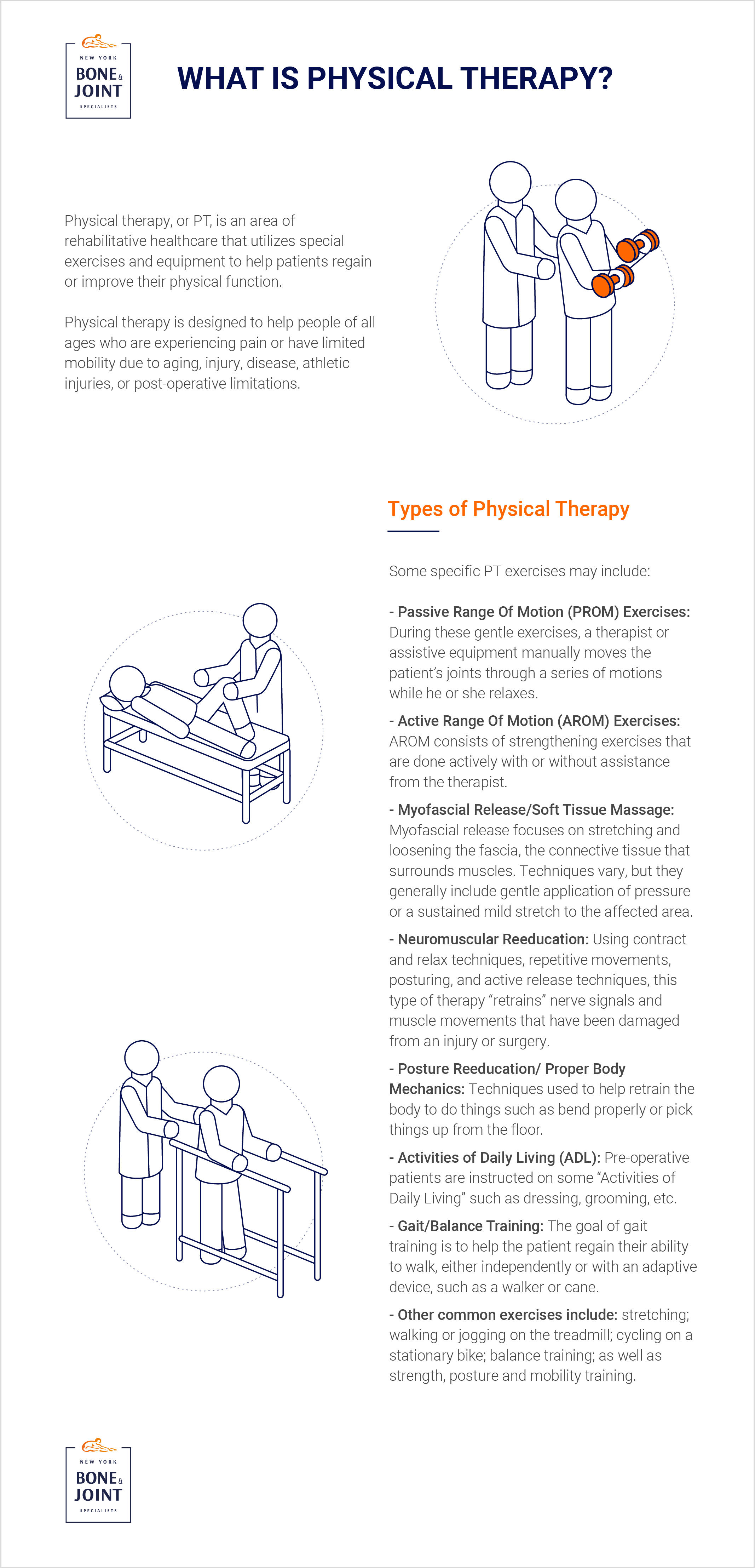
New York Bone & Joint physical therapists use a range of evidence-based treatment approaches calibrated to each patient’s condition, stage of recovery, and goals.
| Approach | What It Does | Used For |
| Manual therapy and soft tissue mobilization | Hands-on techniques to reduce pain, improve joint mobility, and address soft tissue restrictions. Includes joint mobilization, myofascial release, and soft tissue massage. | Post-surgical stiffness, frozen shoulder, chronic pain, muscle tightness |
| Therapeutic exercise | Individualized strengthening, stretching, and neuromuscular training programs progressed through phases of recovery. | All conditions: the core of every physical therapy program |
| Neuromuscular re-education | Targeted exercises to restore normal nerve-muscle coordination patterns disrupted by injury or surgery. | Post-ACL, post-stroke, post-surgical inhibition patterns |
| Gait and movement analysis | Assessment and retraining of walking, running, and sport-specific movement patterns. | Post-surgical return to sport, running injuries, lower extremity mechanics |
| TENS and electrical stimulation | Low-voltage electrical current to reduce pain and stimulate muscle contraction. | Pain management, post-surgical muscle activation, swelling reduction |
| Ultrasound therapy | Sound waves to promote tissue healing, reduce scar tissue, and decrease inflammation. | Tendinopathies, soft tissue injuries |
| Heat and cold therapy | Superficial heat for muscle relaxation and circulation; cold therapy for swelling and acute pain management. | Adjunct to exercise programs; post-session recovery |
| Sport-specific and return-to-performance training | Sport-specific movement patterns, agility drills, and functional testing as the final phase of rehabilitation. | Athletes preparing to return to competitive sport or performance |
Return to Sport and Activity: Criteria-Based, Not Time-Based
One of the most consequential decisions in post-operative rehabilitation is when to clear a patient for return to sport. Time-based clearance (that is, your doctor saying, “6 months post-ACL, you’re cleared”) has been shown to produce re-injury rates significantly higher than criteria-based clearance, in which specific functional and strength benchmarks must be met before return to full activity. [3]
At New York Bone & Joint, return-to-sport clearance requires:
- Strength symmetry testing: The recovering limb must achieve at least 90% of the strength of the unaffected limb on standardized testing before clearance for full sport.
- Functional movement assessment: Sport-specific functional tests demonstrating appropriate movement patterns, landing mechanics, and neuromuscular control.
- Physician sign-off: Final clearance from the treating physician, not just the physical therapist, based on objective test results and clinical examination.
- Patient education: Every patient understands what the criteria mean, why they exist, and what the re-injury risk data shows for athletes who return before meeting them.
“I never clear an athlete to return to sport because six months have passed. I clear them when the criteria are met. Sometimes that’s month seven. Sometimes it’s month nine. The criteria exist because the literature on re-injury rates is unambiguous: time-based return produces more ACL re-tears, more re-injuries, and worse long-term outcomes than criteria-based return. [3] Our physical therapy team is trained to apply these criteria rigorously. The patient’s urgency to return is understandable. My job is to make sure that urgency doesn’t cost them another twelve months of recovery.” — Dr. Leon Popovitz, MD
Physical Therapy and PMR: A Diagnostic Interface Unique to New York Bone & Joint
Physical therapy and physical and rehabilitative medicine (PMR) overlap at a diagnostically important intersection: the patient whose physical therapy progress has stalled for reasons that are not purely biomechanical. Nerve injury, radiculopathy, nerve entrapment, and peripheral neuropathy can all present as weakness or movement limitations that look like physical therapy problems. None of these concerns will respond to physical therapy intervention until the underlying nerve pathology is identified and addressed.
At New York Bone & Joint, Dr. Michael Mizhiritsky, MD, co-founder and physiatrist, performs electromyography (EMG) and nerve conduction studies in the same center as the physical therapy department. When Cecilia Manubay or the physical therapy team identifies a patient whose progress pattern raises a diagnostic question, the referral to Dr. Mizhiritsky happens within the practice, the same week. His findings come back directly to the physical therapy team. The protocol adjusts.
“The cases that test a physical therapy program most are not the straightforward ones. They are the patients who are doing everything right and still not progressing on schedule. In most practices, figuring out why requires a separate referral chain that takes weeks. At New York Bone & Joint, the physiatrist is down the hall and the EMG can usually be scheduled within days. We find the answer faster, and the physical therapy program adapts faster. That is the advantage of the integrated model that most practices cannot replicate.” — Dr. Michael Mizhiritsky, MD
Why Choose New York Bone & Joint for Physical Therapy?
| New York Bone & Joint Advantage | What it Means for You |
| Same center as your surgeon | Your physical therapist reads the operative report. Your surgeon knows your progress. Protocol adjustments happen the same day, not across a referral chain. |
| Criteria-based return to sport | Clearance when you’ve met the objective benchmarks, not when the calendar says six months. Re-injury rates are significantly lower with criteria-based clearance. [3] |
| 15+ years of PT leadership | Cecilia Manubay has led the New York Bone & Joint physical therapy department through thousands of post-operative cases. The protocols are not generic templates, they are clinically refined over years of outcome data. |
| PMR and EMG in-house | When physical therapy progress stalls for diagnostic reasons, Dr. Mizhiritsky’s EMG and nerve conduction services are in the same center. No separate referral, no weeks of waiting for an answer. |
| Non-operative and post-operative | New York Bone & Joint physical therapy is not just for surgical patients. Sports injuries, chronic pain, back and neck conditions, and all categories of orthopedic physical therapy are treated here. |
| Direct physician communication | Your physical therapist, surgeon, sports medicine physician, and physiatrist all work in the same practice. No information gets lost between separate systems. |
| Both Manhattan locations | Full physical therapy services at Upper East Side and Midtown. Convenient to patients throughout Manhattan. |
References
- American Academy of Orthopaedic Surgeons. Physical Therapy. OrthoInfo. orthoinfo.aaos.org/en/treatment/physical-therapy
- Palmieri-Smith RM et al. Functional Resistance Training Improves Thigh Muscle Strength after ACL Reconstruction: A Randomized Clinical Trial. Med Sci Sports Exerc. 2022. pubmed.ncbi.nlm.nih.gov/35551165
- Gokeler A et al. Quadriceps function following ACL reconstruction and rehabilitation: implications for optimisation of current practices. Knee Surg Sports Traumatol Arthrosc. 2014. pubmed.ncbi.nlm.nih.gov/23812438
- Lawford BJ et al. Exercise for osteoarthritis of the knee. Cochrane Database Syst Rev. 2024. pubmed.ncbi.nlm.nih.gov/39625083
- Katz JN et al. Surgery versus physical therapy for a meniscal tear and osteoarthritis. N Engl J Med. 2013. pubmed.ncbi.nlm.nih.gov/23506518
- Hayden JA et al. Exercise therapy for treatment of non-specific low back pain. Cochrane Database. 2005. pubmed.ncbi.nlm.nih.gov/16034851
- Jung C et al. Rehabilitation following rotator cuff repair. Obere Extrem. 2018. pmc.ncbi.nlm.nih.gov/articles/PMC5834570
- Ferreira ML et al. Comparison of general exercise, motor control exercise, and spinal manipulative therapy for chronic low back pain. Pain. 2007. pubmed.ncbi.nlm.nih.gov/17250965
- van Grinsven S et al. Evidence-based rehabilitation following anterior cruciate ligament reconstruction. Knee Surg Sports Traumatol Arthrosc. 2010. pubmed.ncbi.nlm.nih.gov/20069277
- American Physical Therapy Association. Clinical Practice Guidelines. apta.org
FAQs
Physical therapy is a healthcare discipline that uses therapeutic exercise, manual techniques, and functional training to restore movement, reduce pain, and improve physical function after injury, surgery, or with chronic musculoskeletal conditions. [1] At New York Bone & Joint, physical therapy is provided as an integrated service within the same practice as orthopedic surgeons, sports medicine physicians, and a physiatrist, not as a separate referral destination. Your physical therapist reads your operative report, communicates directly with your physician, and builds your protocol from the clinical information that your treatment produced.
New York Bone & Joint patients can be referred to the in-house physical therapy department directly by their New York Bone & Joint physician, and new patients can also schedule a physical therapy evaluation directly without a referral for most conditions. For post-operative patients, the physical therapy referral is coordinated by the surgical team as part of the discharge process. For non-operative patients and new patients, call 212-759-4553 or book online. Insurance requirements for physical therapy vary by plan. New York Bone & Joint staff will verify your coverage before your first appointment.
The duration of physical therapy depends on the condition, the procedure performed (for post-operative patients), and the patient’s individual response, ranging from a few weeks for acute soft tissue injuries to 6–9 months for post-ACL reconstruction rehabilitation. [2] Your physical therapist will provide a realistic timeline at your first session after completing the initial evaluation. At New York Bone & Joint, post-operative timelines are set based on criteria-based milestones and not calendar-based defaults. You progress when you have met the clinical criteria, which sometimes means faster than the standard timeline and sometimes means more conservatively.
Your first physical therapy session at New York Bone & Joint includes a clinical evaluation of your current range of motion, strength, movement patterns, and functional limitations followed by the development of a specific treatment plan for your condition and goals. For post-operative patients, your therapist will have reviewed your operative report before the session. For non-operative patients, your therapist will review your physician’s evaluation notes. You will not receive a generic exercise sheet. Wear comfortable clothing that allows access to the affected area.
Yes, New York Bone & Joint provides structured post-ACL reconstruction rehabilitation in-house, with a protocol built from the operative report and coordinated directly between the physical therapy team and the operating surgeon. [9] Clearance to return to sport requires meeting objective strength symmetry criteria (typically 90%+ of the unaffected limb) and passing functional movement assessments, not just reaching a time threshold. Studies show that criteria-based return-to-sport protocols significantly reduce ACL re-injury rates compared to time-based return. [3]
Yes, New York Bone & Joint provides post-rotator cuff repair rehabilitation with a protocol specifically calibrated to the size and technique of the repair as documented in the operative report. [7] The external rotation restriction and progressive loading parameters in the early weeks are the most critical variables in rotator cuff rehabilitation, and they are set by the operating surgeon based on what was found and repaired intraoperatively, not by a generic protocol. Direct communication between the New York Bone & Joint physical therapy team and the surgeon is built into the program.
Yes, New York Bone & Joint physical therapy accepts patients who are seeking non-operative physical therapy and patients who had surgery at other practices but want to complete their rehabilitation at New York Bone & Joint. For patients transferring post-operative physical therapy to New York Bone & Joint from another surgical practice, your therapist will request the operative report from your surgeon. For non-operative patients, an evaluation by an New York Bone & Joint physician can be arranged if needed, or physical therapy can begin directly based on your existing diagnosis and imaging.
Physical therapy focuses on restoring movement, strength, and function through exercise and manual techniques; PMR (physical & rehabilitative medicine) is a medical specialty practiced by a physician who diagnoses and manages neuromuscular and musculoskeletal conditions, including performing EMG and nerve conduction studies. At New York Bone & Joint, Michael Mizhiritsky, MD (co-founder, physiatrist), provides PMR services including EMG in the same center as the physical therapy department. When a patient’s physical therapy progress raises a diagnostic question, the two services communicate directly and immediately: an advantage not available in most physical therapy-only settings.
Most major insurance plans cover physical therapy for medically indicated conditions, including both post-operative rehabilitation and non-operative orthopedic conditions, when properly documented. Coverage varies by plan, number of visits covered, and whether a physician referral is required. New York Bone & Joint staff will verify your specific coverage before your first appointment and provide a clear picture of your out-of-pocket responsibility. Call 212-759-4553 or ask during your consultation.
Medically Reviewed by Dr. Popovitz.
You can book your appointment with New York Bone & Joint online by submitting the appointment request form here:
Book an appointmentOur Locations
-
Upper East Side: Full Service Orthopedic Center & Walk-In
1198 3rd Avenue, Between 69th and 70th Street New York, NY 10021Physicians: Monday–Friday 8:00am–6:00pm, Saturday 8:00am–5:00pm
Physical Therapy: Monday–Friday 7:00am–7:30pm, Saturday 8:00am–3:00pm
Sunday: ClosedPhone: (212) 759-4553 -

Orthopedic Doctor Midtown Manhattan NYC — New York Bone & Joint Specialists
425 Madison Ave, Suite 200 (second floor) New York, NY 10017 (corner of East 49th Street)Physician appointments: Mon–Fri 8:00 am–6:00 pm
Physical therapy: Mon–Fri 7 am–7:30 pm, Sat 8 am–3 pmPhone: (212) 759-4553 -

Orthopedic Doctor Upper East Side NYC — New York Bone & Joint Specialists
130 E 67th St New York, NY 10065Currently ClosedPhone: (212) 759-4553