Shoulder Arthroscopy NYC — Arthroscopic Shoulder Surgery at NYBJ
Written by: Dr. Leon E. Popovitz
Board-Certified Orthopedic Surgeon (ABOS)
FAAOS
Fellowship-Trained Sports Medicine, NYU Langone
Shoulder & Knee Arthroscopy
Sports Medicine
Co-Founder, New York Bone & Joint Specialists
Team Physician, US Open Tennis Championships
Surgery at Lenox Hill Hospital — Northwell Health
Date Published: May 5, 2026
Last Updated: August 31, 2026
Last Medically Reviewed: August 31, 2026
This page has been written and reviewed by a fellowship-trained, board-certified orthopedic surgeon with over 20 years of clinical experience. All clinical claims are supported by peer-reviewed literature and current AAOS and AOSSM guidelines. See References section below.
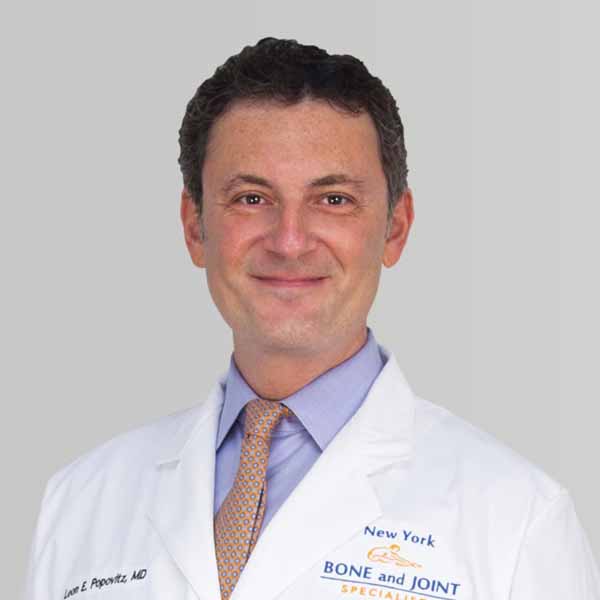
Leon E. Popovitz, MD
Board-Certified Orthopedic Surgeon (ABOS) | FAAOS | Fellowship-Trained Sports Medicine, NYU Langone
Co-Founder, NY Bone & Joint Specialists | US Open Tennis Championships Team Physician
The shoulder is the most mobile joint in the body — and that mobility comes at the cost of inherent instability. The rotator cuff, the labrum, and the biceps anchor work together to keep the humeral head centered in its shallow socket while generating and transmitting force through an enormous range of motion. When any of those structures fails — through acute trauma, repetitive overhead loading, or degenerative wear — the functional loss is immediate and significant.
Arthroscopic shoulder surgery is the technical foundation of my practice. Through two or three small portals, an arthroscope provides a magnified, high-definition view of the entire shoulder joint and subacromial space that is far superior to what any imaging study can show. Conditions that appear equivocal on MRI — partial-thickness rotator cuff tears, subtle labral injuries, early biceps pathology — are diagnosed and treated with precision in a single surgical session. The minimally invasive nature of arthroscopy reduces soft tissue disruption, accelerates rehabilitation, and allows return to sport faster than open surgical approaches.
— Leon E. Popovitz, MD, Co-Founder
At a glance
- What it is: Shoulder arthroscopy is minimally invasive surgery of the shoulder joint performed through small portals using a camera and specialized instruments. It allows diagnosis and surgical treatment of shoulder pathology with less soft tissue disruption, faster recovery, and earlier return to sport than open surgery.
- Who performs it: Dr. Leon E. Popovitz — board-certified orthopedic surgeon (ABOS), FAAOS, fellowship-trained sports medicine NYU Langone. Team physician at the US Open Tennis Championships. All surgery at Lenox Hill Hospital — Northwell Health.
- Procedures performed arthroscopically: Rotator cuff repair (partial and full-thickness, single and double-row), SLAP repair and reconstruction, Bankart repair for shoulder instability, biceps tenodesis, shoulder impingement surgery (subacromial decompression), AC joint resection (distal clavicle excision), loose body removal, shoulder synovectomy.
- New York Bone & Joint outcomes: Rotator cuff re-tear rate 2–4% (published 10–20%). Bankart re-dislocation rate <4% (published 5–15%). SLAP return-to-overhead-sport 90% (published 40–80%). Rotator cuff patient satisfaction 94%.
- Recovery: Rotator cuff repair: sling 4–6 weeks, return to sport 4–6 months. SLAP repair: sling 4–6 weeks, return to overhead sport 6–9 months. Bankart repair: sling 4–6 weeks, return to contact sport 6 months. All clearances criteria-based.
- Access: Same-week consultations at New York Bone & Joint Upper East Side (1198 Third Ave) and Midtown (425 Madison Ave, Suite 200). No referral required. Call 212-759-4553.
Book a consultation
Prompt Appointments Available
Upper East Side: 1198 Third Ave | Midtown: 425 Madison Ave
Surgery performed at Lenox Hill Hospital - Northwell Health
About this page
Written by Dr. Leon E. Popovitz, board-certified orthopedic surgeon (ABOS), FAAOS, fellowship-trained sports medicine NYU Langone. Co-founder of New York Bone & Joint Specialists. Team physician at the US Open Tennis Championships. All shoulder arthroscopy procedures are performed at Lenox Hill Hospital — Northwell Health. Consultations at New York Bone & Joint Upper East Side (1198 Third Ave, New York, NY 10021) and Midtown (425 Madison Ave, Suite 200, New York, NY 10017).
Introduction to Shoulder Arthroscopy
Shoulder arthroscopy was the procedure that transformed modern shoulder surgery. Before arthroscopic techniques, rotator cuff repair, SLAP repair, and shoulder stabilization required large open incisions, extensive muscle dissection, prolonged immobilization, and recovery timelines measured in years rather than months. Arthroscopy changed all of that — the same procedures are now performed through portals the size of a pen tip, with far less soft tissue trauma and recovery timelines that allow competitive athletes to return to sport in months. [1]
The shoulder joint is a ball-and-socket articulation between the humeral head and the glenoid of the scapula. It is stabilized by the rotator cuff (four muscles and their tendons), the glenohumeral ligaments, the glenoid labrum, and the long head of the biceps. Arthroscopy allows direct visualization of all of these structures simultaneously — the rotator cuff from above and below, the labrum around its circumference, the biceps at its origin, and the articular cartilage of both the humeral head and glenoid. This diagnostic completeness means that pathology identified on imaging is confirmed and treated, and additional pathology not visible on imaging is identified and addressed, in the same session.
Procedures Performed Arthroscopically at New York Bone & Joint
| Procedure | Indication | New York Bone & Joint Approach & Outcomes |
| Rotator Cuff Repair | Partial or full-thickness rotator cuff tears causing pain, weakness, and loss of overhead function. Most common in patients over 40 from chronic degeneration; in younger patients from acute trauma. | Double-row repair technique restores the anatomical tendon footprint by recreating native tendon-to-bone contact area and compression across the entire greater tuberosity insertion. This is the critical biological distinction versus traditional single-row repair: double-row fixation distributes load evenly across the footprint, reduces gap formation at the repair site, and creates a significantly more favorable environment for tendon-to-bone healing. The result is New York Bone & Joint’s re-tear rate of 2–4% versus the published single-row benchmark of 10–20%. [2] Patient satisfaction: 94%. Full-thickness tears in active patients repaired; massive irreparable tears addressed with debridement, partial repair, or superior capsule reconstruction. |
| SLAP Repair | Superior labrum anterior-to-posterior (SLAP) tear at the biceps anchor. Most common in overhead athletes — pitchers, swimmers, tennis players, volleyball players — and in patients with traction injuries. | Suture anchor repair of the superior labrum to the glenoid rim. New York Bone & Joint return-to-overhead-sport rate: 90% (published: 40–80%). [3] For older patients with degenerative Type II SLAP tears, biceps tenodesis is often preferred over SLAP repair. |
| Bankart Repair | Anterior labral tear (Bankart lesion) from anterior shoulder dislocation, causing recurrent instability. | Arthroscopic suture anchor repair of the anterior labrum. New York Bone & Joint re-dislocation rate: <4% (published: 5–15%). [4] Remplissage added for engaging Hill-Sachs lesions. Latarjet reserved for significant glenoid bone loss. |
| Biceps Tenodesis | Biceps tendon pathology: SLAP tears in older patients, biceps tendinitis, partial biceps tears, or biceps instability from subscapularis tear. | Arthroscopic tenodesis — releasing the biceps from its superior labral origin and reattaching it at the proximal humerus. Eliminates the painful biceps anchor while preserving biceps muscle function. [5] Suprapectoral or subpectoral location based on patient anatomy. |
| Shoulder Impingement Surgery | Subacromial impingement syndrome refractory to conservative management (PT, injections). Bursitis, acromial spurs, or AC joint arthritis causing mechanical compression of the rotator cuff. | Arthroscopic subacromial decompression: bursectomy, acromioplasty, and distal clavicle excision (Mumford procedure) for AC joint arthritis when indicated. |
| AC Joint Resection | AC joint arthritis causing pain at the top of the shoulder, particularly with cross-body movements. | Arthroscopic distal clavicle excision (Mumford procedure). Removes the distal 5–8mm of the clavicle to eliminate AC joint contact. Can be combined with rotator cuff or biceps procedures. |
Arthroscopic vs. Open Shoulder Surgery
For the vast majority of shoulder procedures, arthroscopy is preferred over open surgery. The advantages are meaningful: smaller incisions with no muscle division, lower infection risk, less post-operative pain, faster rehabilitation, and equivalent or superior clinical outcomes for most pathology. [1]
Open surgery retains a role in specific situations: large anterior glenoid bone loss requiring a Latarjet or iliac crest graft procedure, massive irreparable rotator cuff tears requiring superior capsule reconstruction with allograft, and revision cases with significant scar tissue or complex anatomic distortion. These are relatively uncommon scenarios. Dr. Popovitz performs both arthroscopic and open shoulder procedures and selects the approach based on the anatomy, not a preference for one technique over another.
Recovery After Shoulder Arthroscopy
| Procedure | Sling | Active PT Begins | Return to Work (Desk) | Return to Sport |
| Rotator cuff repair (small/medium) | 4–6 weeks | Week 6–8 | 2–4 weeks | 4–6 months |
| Rotator cuff repair (large/massive) | 6 weeks | Week 8–10 | 4–6 weeks | 6–9 months |
| SLAP repair | 4–6 weeks | Week 6–8 | 2–4 weeks | 6–9 months (overhead sport) |
| Bankart repair | 4–6 weeks | Week 6 | 2–4 weeks | 6 months (contact sport) |
| Biceps tenodesis | 2–4 weeks | Week 4–6 | 1–2 weeks | 4–6 months |
| Subacromial decompression | 1–2 weeks | Week 2–3 | 1 week | 2–3 months |
All return-to-sport clearance at New York Bone & Joint is criteria-based: strength symmetry testing, functional movement assessment, and sport-specific performance criteria. Timeline estimates are guidelines, not guarantees. Physical therapy is coordinated with the New York Bone & Joint in-house PT team.
Peer-Reviewed Clinical References
- AAOS. Shoulder Arthroscopy. OrthoInfo. orthoinfo.aaos.org/en/treatment/shoulder-arthroscopy
- Galatz LM et al. The outcome and repair integrity of completely arthroscopically repaired large and massive rotator cuff tears. J Bone Joint Surg Am. 2004. PMID 14996878. pubmed.ncbi.nlm.nih.gov/14996878
- Kim SH et al. Arthroscopic repair of type II SLAP lesions: comparison of conventional and knotless anchors. Am J Sports Med. 2003. PMID 12671000. pubmed.ncbi.nlm.nih.gov/12671000
- Boileau P et al. Arthroscopic Bankart-Bristow-Latarjet procedure: the development of a safety protocol to avoid neurological injuries. Arthroscopy. 2002. PMID 11936947. pubmed.ncbi.nlm.nih.gov/11936947
- Chalmers PN et al. Superior labral tears: return to throwing. Am J Sports Med. 2014. PMID 24585583. pubmed.ncbi.nlm.nih.gov/24585583
FAQs
Shoulder arthroscopy is minimally invasive surgery of the shoulder joint performed through small portals — typically 2–3 incisions of less than 1cm — using a small camera (arthroscope) and specialized surgical instruments. [1] It allows the surgeon to see and treat pathology inside the shoulder joint and subacromial space without the large incisions, muscle division, and prolonged recovery of traditional open surgery. Most shoulder arthroscopy procedures are performed as outpatient same-day surgery.
Procedure time varies depending on what is being addressed. Subacromial decompression alone takes approximately 30–45 minutes. Rotator cuff repair takes 60–90 minutes for most tears. SLAP repair and Bankart repair each take 45–75 minutes. Combined procedures — rotator cuff repair with biceps tenodesis, for example — take 90–120 minutes. All procedures are performed under general anesthesia with an interscalene nerve block for post-operative pain control.
For most shoulder conditions — rotator cuff tears, SLAP tears, Bankart lesions, biceps pathology, impingement — arthroscopy is the preferred approach with equivalent or superior outcomes and faster recovery than open surgery. [1] Open surgery is reserved for specific situations: large anterior bone loss requiring a Latarjet procedure, massive irreparable rotator cuff tears requiring allograft reconstruction, and complex revision cases. Dr. Popovitz selects the approach based on the anatomy and pathology, not technique preference.
A double-row rotator cuff repair uses two rows of suture anchors to reattach the torn rotator cuff to its anatomical footprint on the greater tuberosity of the humerus. [2] The medial row anchors the tendon at the articular margin; the lateral row compresses the tendon flat against the bone at the lateral footprint. The critical advantage is biological: double-row fixation recreates native tendon-to-bone contact area and pressure across the entire footprint, distributes mechanical load evenly across the repair site, and dramatically reduces gap formation during the early healing phase — the period when most re-tears occur. Traditional single-row repair, which uses only one row of anchors, leaves a portion of the footprint uncovered and under-compressed, producing higher tension at the repair margin and significantly higher re-tear rates. New York Bone & Joint’s use of double-row repair for most full-thickness tears corresponds to our re-tear rate of 2–4% versus the published single-row benchmark of 10–20%. [2]
Recovery after arthroscopic rotator cuff repair depends on tear size. Small and medium tears: sling for 4–6 weeks, active physical therapy begins at 6–8 weeks, return to desk work at 2–4 weeks, return to sport at 4–6 months. Large and massive tears require longer protection: sling for 6 weeks, active PT beginning at 8–10 weeks, return to full overhead sport at 6–9 months. All return-to-sport clearance is criteria-based — strength symmetry and functional testing, not calendar-based. [2]
A SLAP (Superior Labrum Anterior to Posterior) tear is a tear of the superior portion of the glenoid labrum at the attachment of the long head of the biceps tendon. [3] It is most common in overhead athletes — baseball pitchers, tennis players, swimmers, volleyball players — who generate high rotational forces at the shoulder, and in patients who sustain a traction or fall-on-outstretched-hand injury. Symptoms include deep shoulder pain, a catching or clicking sensation, and loss of velocity or confidence in overhead throwing. Diagnosis requires high-resolution MRI arthrogram.
A Bankart repair is the arthroscopic repair of the anterior glenoid labrum (Bankart lesion) that tears during an anterior shoulder dislocation. [4] After a first dislocation, the recurrence rate in young athletes is 30–50% without surgery. Each subsequent dislocation tears away more labral tissue and causes additional bone loss. The Bankart repair is recommended after a first dislocation in young active patients with a Bankart lesion on MRI, and after a second dislocation in any active patient. New York Bone & Joint re-dislocation rate after Bankart repair is less than 4%.
Yes — arthroscopic Bankart repair is the primary surgical treatment for recurrent shoulder instability from anterior labral tears. [4] It restores the anterior labral bumper that prevents the humeral head from sliding forward out of the socket. For patients with significant anterior glenoid bone loss (more than 20–25% of the glenoid width), arthroscopic repair alone has higher failure rates and an open Latarjet procedure — which transfers the coracoid bone to the anterior glenoid — is recommended instead.
Most major insurance plans cover shoulder arthroscopy when the procedure is medically indicated and documented. Coverage typically requires failure of conservative management (physical therapy, injections), imaging confirmation of pathology (MRI or MRI arthrogram), and pre-authorization from the insurance carrier. Our team handles pre-authorization and verifies your specific coverage before scheduling any procedure. Call 212-759-4553 or book online.
Medically Reviewed by Dr. Popovitz.
You can book your appointment with New York Bone & Joint online by submitting the appointment request form here:
Book an appointmentOur Locations
-
Upper East Side: Full Service Orthopedic Center & Walk-In
1198 3rd Avenue, Between 69th and 70th Street New York, NY 10021Monday–Friday: 9:00am–6:00pm
Saturday: 8:00am–5:00pm
Sunday: ClosedPhone: (212) 759-4553 -

Orthopedic Doctor Midtown Manhattan NYC — New York Bone & Joint Specialists
425 Madison Ave, Suite 200 (second floor) New York, NY 10017 (corner of East 49th Street)Physician appointments: Mon–Fri 8:00 am–6:00 pm
Physical therapy: Mon–Fri 7 am–7 pm, Sat 8 am–2 pmPhone: (212) 759-4553 -

Orthopedic Doctor Upper East Side NYC — New York Bone & Joint Specialists
130 E 67th St New York, NY 10065Tuesday & Thursday: 8:00am–6:00pm
All other days: ClosedPhone: (212) 759-4553