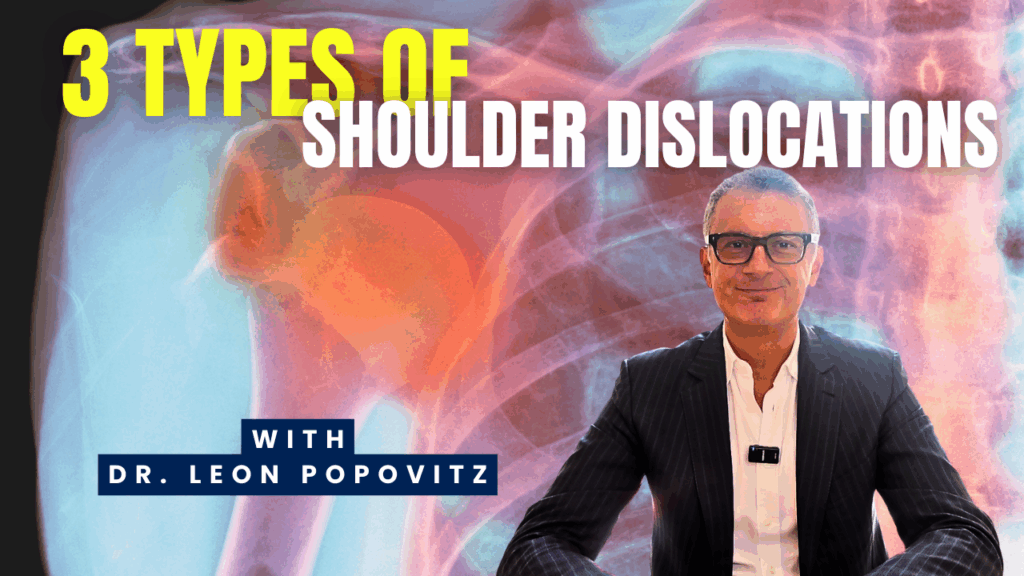
Shoulder dislocations are a common orthopedic injury, but they’re often misunderstood. In this post, we’ll break down the different types of shoulder dislocations, who is most at risk, and the treatment approaches that can help restore function and prevent long-term damage.
What is a Shoulder Dislocation?
A shoulder dislocation occurs when the upper arm bone (humerus) slips out of the shoulder socket. This can happen due to trauma, injury, or underlying joint instability. Shoulder dislocations can be painful, lead to weakness, and if untreated, may cause recurrent dislocations or even premature arthritis.
Types of Shoulder Dislocations
There are three main scenarios in which shoulder dislocations typically occur:
1. Traumatic Shoulder Dislocations in Young Adults
Traumatic dislocations most often affect younger patients, generally under the age of 40. These injuries commonly occur during sports, falls, or accidents where the shoulder experiences a sudden force.
- Direction: Most traumatic dislocations in young adults occur anteriorly, meaning the shoulder dislocates forward.
- Associated Injuries: These dislocations frequently cause a Bankart lesion, a tear of the labrum (cartilage rim of the shoulder socket) and its associated ligaments. This tear leaves a “bare area” of bone and destabilizes the joint.
- Risk of Recurrence: Studies show that younger patients, particularly those under 20, have a very high risk of recurrent dislocations, sometimes over 90%.
- Treatment: Due to the high recurrence rate, surgical stabilization is often recommended to repair the labrum and ligaments, restore shoulder stability, and reduce the risk of long-term complications like arthritis.
2. Traumatic Shoulder Dislocations in Older Adults
Shoulder dislocations in patients over 60 typically involve a different mechanism and injury pattern:
- Cause: These dislocations often result from falls and are usually associated with a rotator cuff tear.
- Symptoms: Older patients may experience weakness, pain, and difficulty raising the arm.
- Treatment: Surgical repair of the rotator cuff is usually recommended to restore shoulder strength, function, and prevent further damage or arthritis.
3. Multi-Directional Instability (Ligamentous Laxity)
Some patients experience shoulder dislocations without trauma. This condition is called multi-directional instability and is often seen in individuals with naturally loose joints, sometimes referred to as being “double-jointed.”
- Characteristics: These patients can dislocate their shoulder voluntarily or experience recurrent dislocations in multiple directions—forward, backward, or downward.
- Treatment Approach: Surgery is generally avoided unless the instability causes severe symptoms. Even with surgical intervention, the flexible tissues in these patients may loosen over time, potentially leading to future dislocations. Conservative treatments such as physical therapy and strengthening exercises are preferred.
Key Takeaways on Shoulder Dislocation Treatment
- Young adults with traumatic dislocations: Surgical stabilization is often necessary to repair labral and ligament injuries and prevent recurrence.
- Older adults with traumatic dislocations: Rotator cuff repair may be needed to restore strength and function.
- Patients with multi-directional instability: Conservative treatment is prioritized, with surgery reserved for severe, persistent cases.
Understanding the type of shoulder dislocation is critical for choosing the right treatment approach and ensuring the best outcomes.
Why Choose New York Bone & Joint Specialists?
At NY Bone & Joint Specialists, we combine cutting-edge surgical techniques with personalized care to help our patients recover safely and effectively. Our team specializes in shoulder injuries, including dislocations, rotator cuff tears, and labral repairs, providing expert guidance every step of the way.
If you or a loved one has experienced a shoulder dislocation, contact us today to schedule a consultation with our orthopedic specialists and learn more about your treatment options.