Shoulder Dislocations in Young Athletes: Why the First Injury Matters
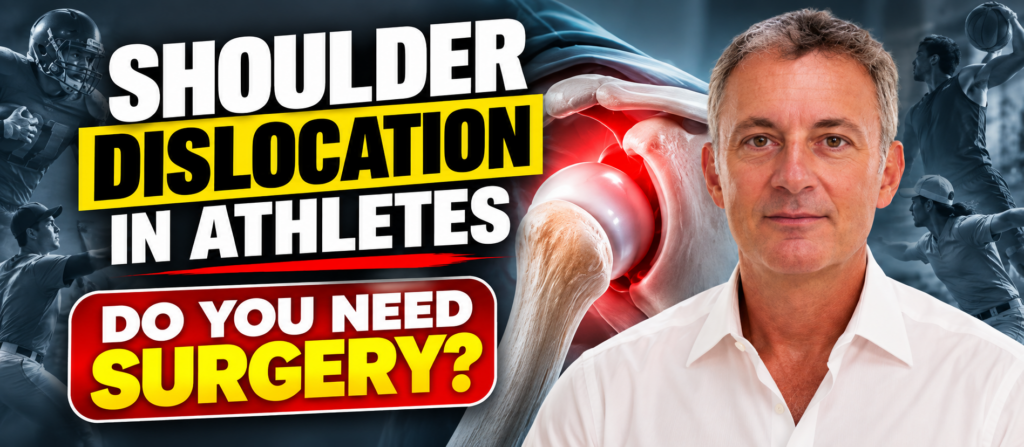
A shoulder dislocation is more than an extremely painful injury. Particularly in young, active patients, the damage caused by a first traumatic dislocation can create ongoing shoulder instability and potentially lead to recurrent dislocations, bone loss, cartilage damage, and more complicated treatment later.
Dr. Leon Popovitz, board-certified orthopedic surgeon and co-founder of New York Bone & Joint Specialists, explains what happens during a shoulder dislocation, why young athletes face a particularly high risk of recurrence, and why appropriate treatment after the first injury can be critical to protecting the shoulder long-term.
What Happens When a Shoulder Dislocates?
The shoulder is a ball-and-socket joint. The humeral head forms the “ball,” while the glenoid forms the relatively shallow socket.
The most common shoulder dislocation occurs anteriorly, meaning the humeral head is forced out toward the front of the joint. Because a true dislocation generally requires significant force, patients may hear or feel a pop and typically experience substantial pain and a visible change in the contour of the shoulder.
But the damage may extend well beyond the temporary displacement of the joint.
What Is a Bankart Lesion?
During a traumatic anterior shoulder dislocation, the labrum—the cartilage surrounding the socket—can tear away from the front and lower portion of the glenoid. This injury is known as a Bankart lesion.
The labrum contributes to shoulder stability, and important stabilizing ligaments attach to it. When these structures are damaged, the shoulder can become unstable and susceptible to additional dislocations or subluxations.
A subluxation occurs when the shoulder partially shifts out of position and then moves back into place rather than completely dislocating.
For young, highly active patients with a traumatic dislocation and Bankart lesion, Dr. Popovitz explains that the risk of recurrent instability can be particularly high. Pasted text
Why Young Athletes Require Special Consideration
Age and activity level can significantly influence treatment decisions.
Younger patients generally have more elastic tissue and may be particularly susceptible to recurrent instability following a traumatic dislocation. In contrast, older patients who experience a dislocation may be more likely to sustain an associated rotator cuff injury. Pasted text
For a young competitive athlete, returning to play as quickly as possible may understandably be the immediate concern. However, treatment decisions also need to consider the long-term health of the joint.
Repeated instability can gradually damage the shoulder’s anatomy.
What Happens If Shoulder Instability Is Left Untreated?
Repeated dislocations and subluxations can cause the humeral head to repeatedly move against the glenoid.
Over time, this can wear away bone from the socket. As the amount of available glenoid bone decreases, the shoulder may have progressively less structural support keeping the humeral head in position. Pasted text
That can turn a problem that may initially be treatable with a minimally invasive arthroscopic stabilization procedure into one requiring a substantially more complex operation.
Bankart Lesions vs. Bony Bankart Lesions
A traditional Bankart lesion involves the soft tissues of the labrum and associated stabilizing structures.
A bony Bankart lesion, however, occurs when a portion of the glenoid bone itself fractures during the injury. A nondisplaced fracture may sometimes heal without surgical intervention, whereas recurrent instability can create progressive glenoid bone loss that changes the anatomy of the shoulder. Pasted text
MRI can help identify soft-tissue injury and suggest bone loss. When precise measurement of bone loss is necessary for surgical planning, Dr. Popovitz uses a CT scan. Pasted text
When Is a Latarjet Procedure Considered?
When significant glenoid bone loss has occurred, repairing the torn labrum alone may no longer provide sufficient stability.
Dr. Popovitz explains that bone loss in the range of approximately 20–25% can lead to consideration of a Latarjet procedure, bone-grafting procedure, or both, depending on the individual case. Pasted text
The Latarjet is an open shoulder-stabilization procedure in which a portion of the coracoid bone and its attached soft tissue are transferred to the front of the glenoid. This provides additional bony support while also contributing a soft-tissue stabilizing effect. Pasted text
Because this is a more involved procedure, careful diagnosis and preoperative planning are important.
What Happens During an Arthroscopic Bankart Repair?
A Bankart repair can generally be performed arthroscopically through several very small incisions.
A camera allows the surgeon to visualize the inside of the shoulder, while specialized instruments are used to repair the damaged tissue. Dr. Popovitz explains that approximately two to four anchors may typically be used depending on the size of the tear.
A capsular shift may also be performed to tighten the shoulder capsule and provide additional stability. Pasted text
Patients are generally placed into a sling after surgery and, in most cases, can return home the same day.
What Is a Hill-Sachs Lesion?
A shoulder dislocation can also create an indentation or defect in the humeral head known as a Hill-Sachs lesion.
A small Hill-Sachs lesion may simply provide evidence that instability has occurred. With repeated dislocations, however, the defect can become larger. If it becomes large enough to engage with the opposing bone during shoulder movement, additional treatment may be necessary. Pasted text
When Can an Athlete Return to Sports?
Healing after shoulder stabilization cannot be rushed.
Dr. Popovitz generally allows approximately six months before returning to sports conditioning following a Bankart repair. For athletes participating in football or other high-impact activities, he prefers approximately nine months before returning to those activities so the athlete has additional time to condition safely. Pasted text
Recovery is not purely physical, either. A traumatic dislocation can make athletes apprehensive about trusting the shoulder again. Progressive conditioning gives both the repaired tissue and the athlete time to become prepared for the demands of competition.
The First Shoulder Dislocation Can Affect the Future of the Joint
The appropriate treatment for a shoulder dislocation depends on the patient’s age, activity level, anatomy, associated injuries, degree of instability, and other individual factors.
But one principle is especially important: the first dislocation shouldn’t simply be ignored once the shoulder is back in place.
Determining whether there is a Bankart lesion, Hill-Sachs lesion, bone loss, rotator cuff injury, or another associated injury can help establish the appropriate treatment plan and reduce the risk of more significant problems later.
If you’ve experienced a shoulder dislocation or recurrent shoulder instability, the orthopedic specialists at New York Bone & Joint Specialists can evaluate the injury and develop an individualized treatment plan.
Board-Certified Orthopedic Surgeon (ABOS)
Fellow, American Academy of Orthopaedic Surgeons
Co-Founder, NY Bone & Joint Specialists
Team Physician, US Open Tennis Championships
Our Locations
-
Upper East Side: Full Service Orthopedic Center & Walk-In
1198 3rd Avenue, Between 69th and 70th Street New York, NY 10021Physicians: Monday–Friday 8:00am–6:00pm, Saturday 8:00am–5:00pm
Physical Therapy: Monday–Friday 7:00am–7:30pm, Saturday 8:00am–3:00pm
Sunday: ClosedPhone: (212) 759-4553 -

Orthopedic Doctor Midtown Manhattan NYC — New York Bone & Joint Specialists
425 Madison Ave, Suite 200 (second floor) New York, NY 10017 (corner of East 49th Street)Physician appointments: Mon–Fri 8:00 am–6:00 pm
Physical therapy: Mon–Fri 7 am–7:30 pm, Sat 8 am–3 pmPhone: (212) 759-4553 -

Orthopedic Doctor Upper East Side NYC — New York Bone & Joint Specialists
130 E 67th St New York, NY 10065Currently ClosedPhone: (212) 759-4553