Spondylolisthesis: Symptoms, Treatment, & Surgery
Written by: Dr. Popovitz.
Board-Certified Orthopedic Surgeon | Fellowship-Trained Sports Medicine, NYU Langone Medical Center | FAAOS
Co-Founder, NY Bone & Joint Specialists | Lenox Hill Hospital - Northwell Health
Recognized: New York Magazine Best Doctor | New York Times Super Doctor | IAOS Leading Physician of the World | IAOS Top Orthopedic Surgeon in New York
Date Published: November 30, 2018
Last Updated: September 22, 2025
Last Medically Reviewed: September 22, 2025
This page has been written and reviewed by a fellowship-trained, board-certified orthopedic surgeon with over 20 years of clinical experience. All clinical claims are supported by peer-reviewed literature and current AAOS and AOSSM guidelines. See References section below.
Book a consultation
Prompt Appointments Available
Upper East Side: 1198 Third Ave | Midtown: 425 Madison Ave
Surgery performed at Lenox Hill Hospital - Northwell Health
What is Spondylolisthesis
Spondylolisthesis is the displacement or dislocation of a vertebra. It most commonly occurs in the lower back, but it can affect any region of the spinal column. In most cases, the affected vertebra protrudes forward over the vertebra directly beneath it, impinging or compressing the nerves in the back.
Spondylolisthesis Symptoms
Common symptoms of spondylolisthesis include a sudden pain that radiates down the back or buttocks and becomes more severe when bending or twisting, a sense of weakness in the legs, and an inability to walk without significant pain. In particularly extreme cases, it can also lead to incontinence.
Spondylolisthesis Grading
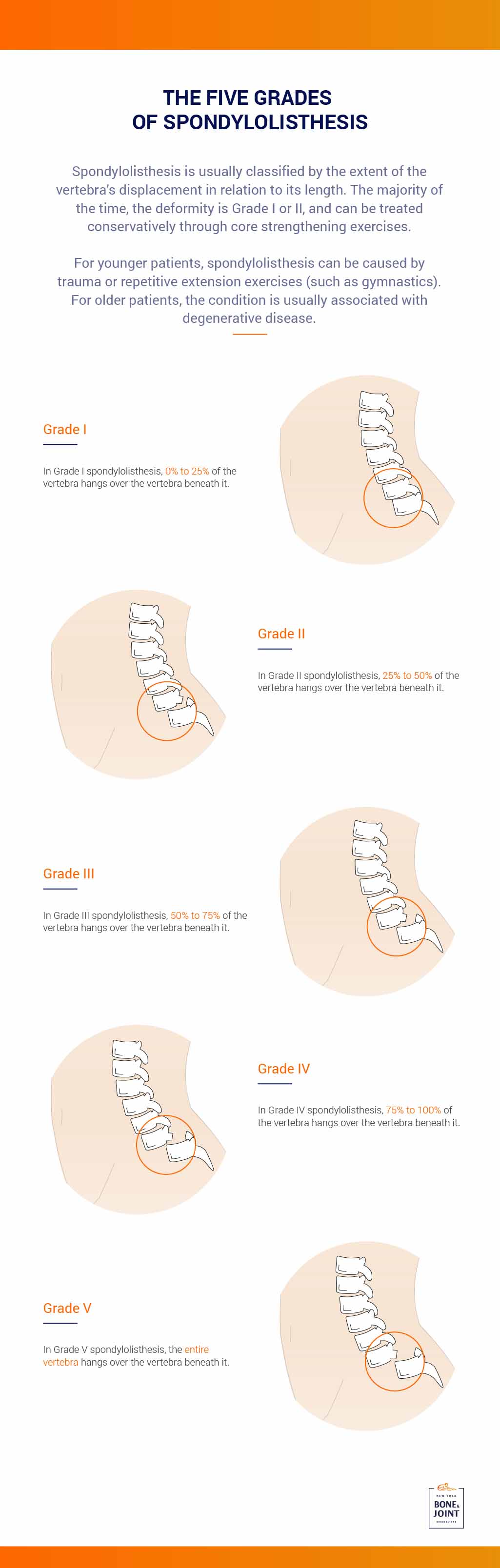
Spondylolisthesis can be categorized by the extent of the displacement in relation to the length of the vertebra. If 30% of a vertebra hangs over the vertebra beneath it, for example, the displacement is a grade 2 case of spondylolisthesis.
Grade 1 Spondylolisthesis
In Grade 1 spondylolisthesis, 0% to 25% of the vertebra hangs over the vertebra beneath it.
Grade 2 Spondylolisthesis
In Grade 1 spondylolisthesis, 25% to 50% of the vertebra hangs over the vertebra beneath it.
Grade 3 Spondylolisthesis
In Grade 1 spondylolisthesis, 50% to 75% of the vertebra hangs over the vertebra beneath it.
Grade 4 Spondylolisthesis
In Grade 1 spondylolisthesis, 75% to 100% of the vertebra hangs over the vertebra beneath it.
Grade 5 Spondylolisthesis
In Grade 1 spondylolisthesis, the entire vertebra hangs over the vertebra beneath it.
Spondylolisthesis Treatment
Treatments for spondylolisthesis depend on the severity of the condition, but most cases respond well to more conservative measures. Indeed, surgery is generally necessary only if the displacement has significantly limited the patient’s ability to function.
Conservative
The first line of treatment for spondylolisthesis is to simply refrain from any activity that might have caused the displacement or could exacerbate it. Minor to moderate pain can be effectively relieved with ibuprofen or acetaminophen. Corticosteroid injections can also alleviate pain and swelling. These treatments should be complemented with a physical therapy program, specifically flexion exercises, which are designed to rebuild the muscles in the core and back while restoring function to the affected vertebra.
Spondylolisthesis Surgery
Should the condition result in damage to the nerves or surrounding vertebrae, spondylolisthesis can also be treated with surgery. During this procedure, your surgeon will remove any bone or tissue that might be compressing the nerves and fuse the vertebrae together to prevent further displacement. This surgery can be performed openly or arthroscopically, and complete recovery can be expected after several months of rest and physical therapy.
Spondylolisthesis: FAQs
What is spondylolisthesis, and what causes it?
Spondylolisthesis is a condition in which one vertebra slips forward over the one below it, potentially causing back pain, nerve irritation, or instability. Common causes include degenerative changes (wear and tear), congenital defects, stress fractures (isthmic type), trauma, or pathology that weakens the bone.
What symptoms should I expect with spondylolisthesis?
Symptoms vary by severity. Many people have mild slippage and little to no symptoms. When present, symptoms often include lower back pain, stiffness, muscle tightness, leg pain or sciatic symptoms, numbness or tingling in the legs or feet, difficulty standing or walking for long periods, and sometimes weakness in the legs. In severe cases, bladder or bowel symptoms may occur.
What non-surgical treatments are available for spondylolisthesis?
Conservative treatment is usually the first step. This can include physical therapy (core & back strengthening, posture correction), use of braces or supports, pain-relieving medications or injections, activity modification, and lifestyle changes (weight management, avoiding aggravating movements). These treatments often help many patients avoid surgery.
When is surgery considered, and what does recovery entail?
Surgery is considered when non-surgical treatments fail to relieve symptoms, when slippage is severe, or when there is neurological impairment (e.g. nerve compression causing weakness or loss of function). Common surgical options include decompressive procedures (e.g. laminectomy or foraminotomy) and spinal fusion to stabilize the spine. Recovery involves several weeks of restricted activity, gradual physical therapy, and may take several months to a year for full recovery depending on the procedure, grade of slippage, patient health, and adherence to rehabilitation.
Doctors Seeing Patients for Spine Conditions:






Medically Reviewed by Dr. Popovitz.
You can book your appointment with New York Bone & Joint online by submitting the appointment request form here:
Book an appointmentOur Locations
-
Upper East Side: Full Service Orthopedic Center & Walk-In
1198 3rd Avenue, Between 69th and 70th Street New York, NY 10021Physicians: Monday–Friday 8:00am–6:00pm, Saturday 8:00am–5:00pm
Physical Therapy: Monday–Friday 7:00am–7:30pm, Saturday 8:00am–3:00pm
Sunday: ClosedPhone: (212) 759-4553 -

Orthopedic Doctor Midtown Manhattan NYC — New York Bone & Joint Specialists
425 Madison Ave, Suite 200 (second floor) New York, NY 10017 (corner of East 49th Street)Physician appointments: Mon–Fri 8:00 am–6:00 pm
Physical therapy: Mon–Fri 7 am–7:30 pm, Sat 8 am–3 pmPhone: (212) 759-4553 -

Orthopedic Doctor Upper East Side NYC — New York Bone & Joint Specialists
130 E 67th St New York, NY 10065Currently ClosedPhone: (212) 759-4553